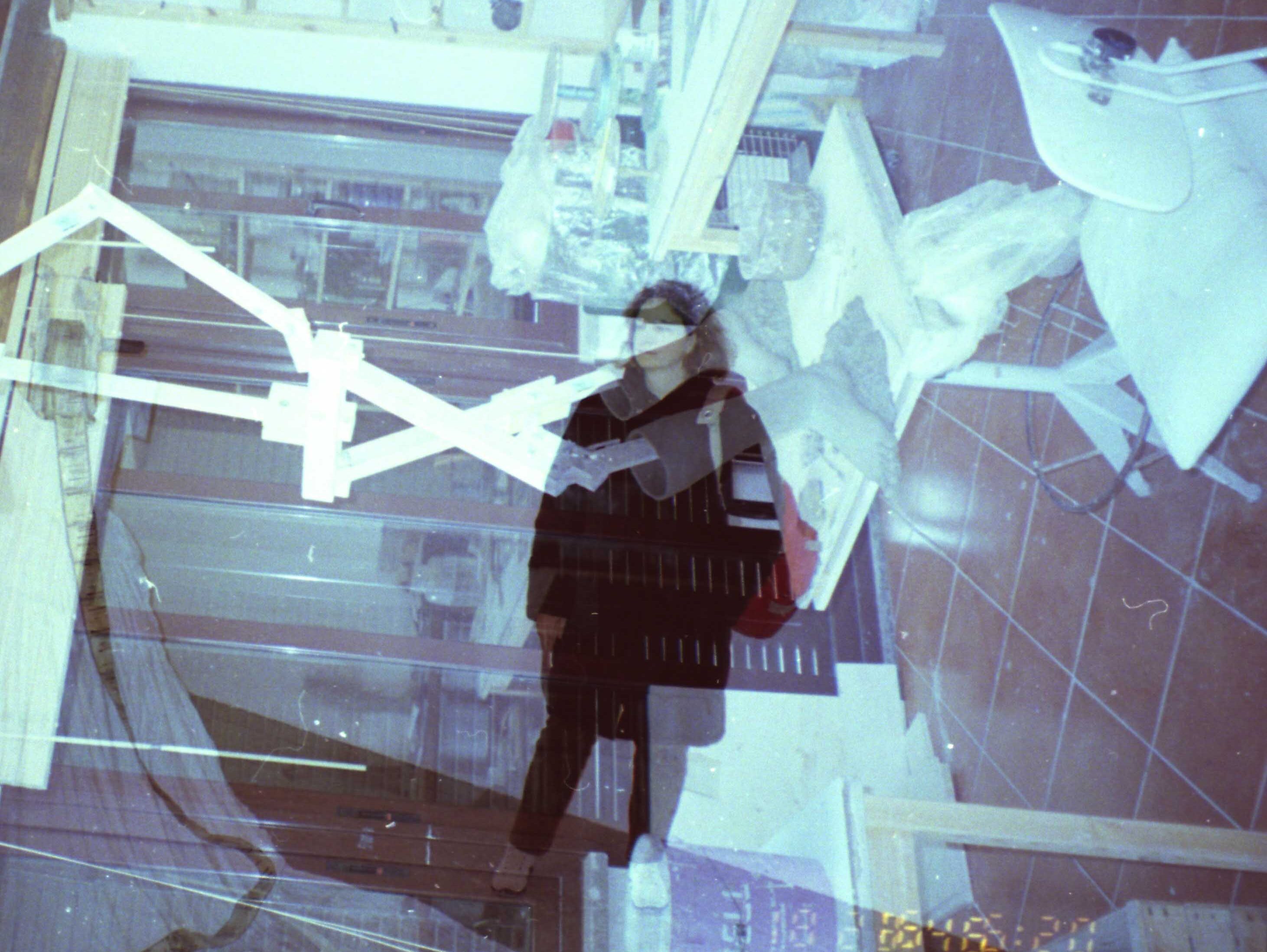
Looking back on your long artistic journey, what experience has most profoundly changed the way you see the world and, consequently, the way you make art? After so many years of artistic research, what still surprises you? Is there something that art continues to teach you that you could never have learned in any other way?
Throughout my artistic journey, there have been many special, surprising, painful, and otherwise profound moments. Each of them has sparked a new flame of imagination, allowing something hidden to emerge. This is what continues to bring me joy to this day, and it keeps happening when I least expect it.
One example comes from long ago: a wild, carefree run through a field of flowering chicory, sending countless tiny blue butterflies into the air, like petals taking flight. Much later, this experience gave rise to the work “Campo di cicoria” (Chicory Field).
Nature runs through much of your work, but it never appears simply as a “subject.” Trees, earth, seeds and landscapes seem to become presences, interlocutors, almost subjects with a voice of their own. When did you begin to experience nature not as something to represent, but as something to enter into a relationship with?
During my childhood, I was fortunate enough to live in and experience a magical place: a real garden where everything, whether a tree, an insect, a cat, or the earth itself, seemed to be mysteriously connected to everything else.
Everything is interconnected, and every living being is a subject in its own right, with a specific form of agency and a right to exist.
Although I have actually planted seeds, planted trees, and used plants in my installations, I believe that presenting them at times as “persons” is a way of emphasizing that non-human beings, too, have the right to be recognized as subjects, including in the eyes of the law.
In Madre terra d’ombra bruciata, you bring together installations, performances, photographs and videos created over many years. It is almost a geography of your artistic research. If you were to look at this “map” today, what would you recognize as its connecting thread?
When I began Madre terra d’ombra bruciata, I did not have a detailed map. The drawings and photographs, installations, performances and videos created over the years gradually began to form groups, scattered islands within fragmented archipelagos, pieces of a puzzle that only later, and rather unexpectedly, found their order, like chapters in a book.
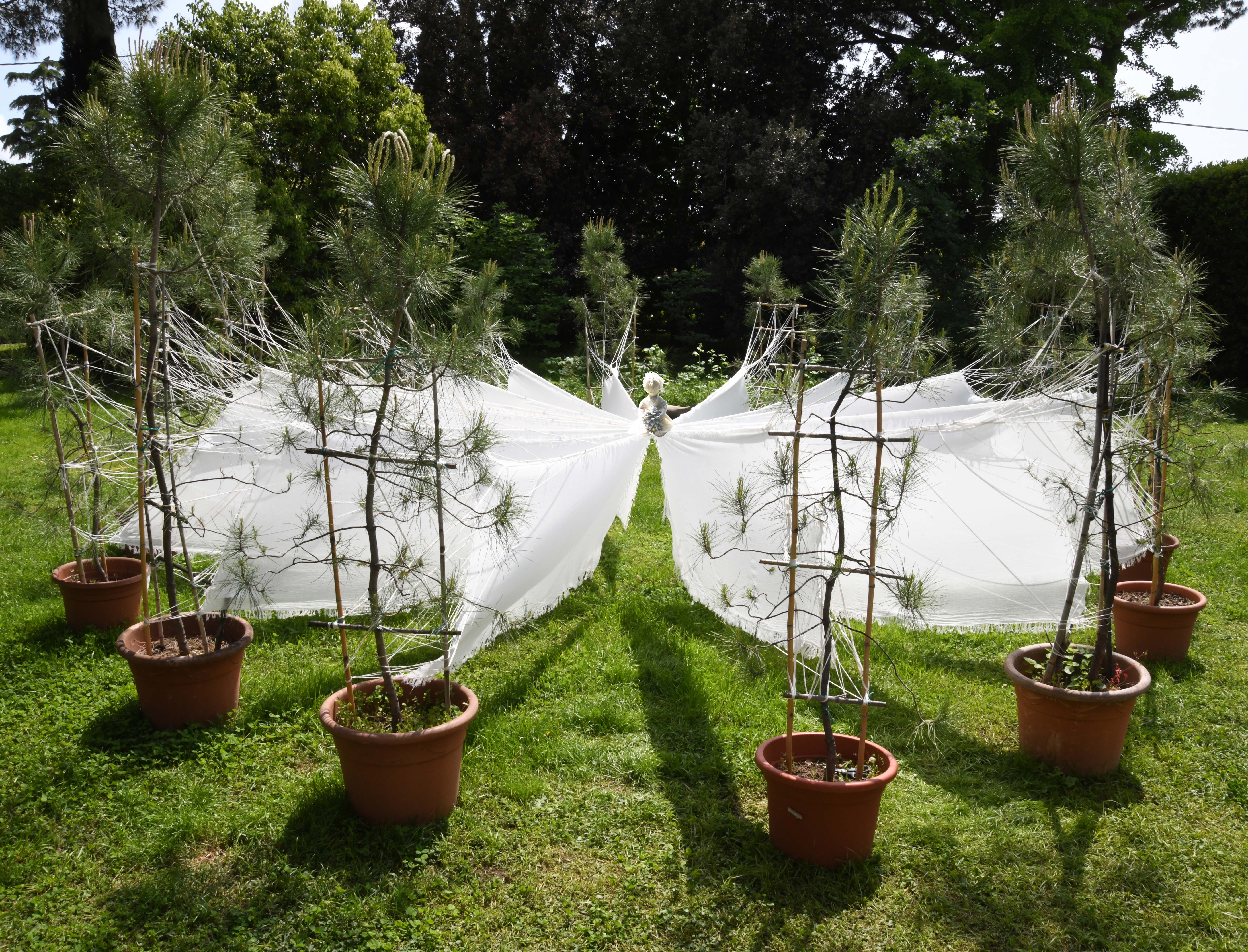
“Pina” has gradually become almost a figure, a character, but also a way of speaking about the tree, identity and transformation. Who is Pina to you today? And how much has she changed alongside you?
“Pina” is the central character in the tactile artist’s book madre terra d’ombra bruciata (Mother Earth of Burnt Shadow). The narratives within the book began almost as a game, when I happened upon some fragments of pine bark and started manipulating them. These fragments were later assembled and developed into sculptures.
Only at a later stage did the feminine side of the tree emerge, revealing that the pine is also inhabited by its other self: “Pina”. A hidden existence, gradually unveiled throughout the process, she eventually becomes a speaking subject with the right to exist. I believe her journey is inextricably intertwined with my own. We can all find a way to become visible as individuals and to be acknowledged for who we are.
Your work often moves through a deeply feminine dimension. I am thinking, for example, of your projects around the mother, the child, the “Pine” figures, and your collaborations with other women artists. What does it mean to speak of the feminine in art today without turning it into a category or a stereotype?
I am a woman born in the 1960s, shaped by the historical and social upheaval that marked the gradual dismantling of patriarchy. The absolute authority of the father as master still prevailed in most families, where he imposed his own laws. But times were changing, and out of this crisis, new ways of being, thinking, and living slowly began to emerge.
Many places, many countries, and all of us, too, are still in transition. There is still much to be done before we can all become free and conscious beings. To me, “exercising power” does not mean subjugating others and making them inferior, whether they are men, women, animals, or plants. Rather, I believe it comes closer to respecting the life and subjectivity of all beings and all things, including the Earth we inhabit.
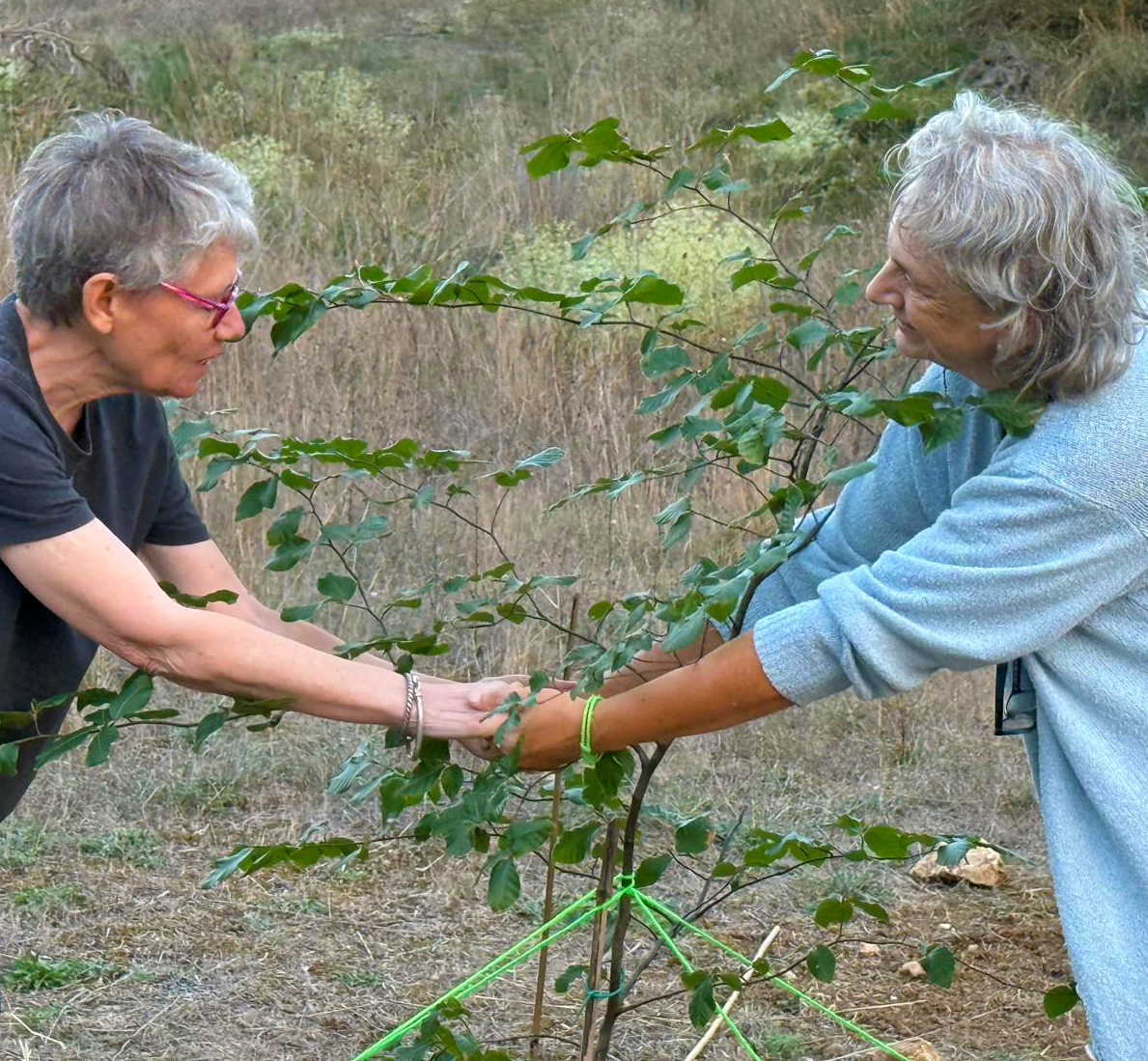
In works such as Un albero vivo per uno morto, the artistic gesture also becomes a concrete, almost ritual act: something dies, something is planted, something continues. Are you interested in art as a possibility of transforming loss into a new form of life?
“One Living Tree for One Dead Tree” emerged from reflecting on the ability of trees, in a healthy habitat, to create an extensive communication network through their roots and fungi. Beyond exchanging all kinds of information, these networks also play an important role in cooperation and mutual support.
What is even more surprising is that these connections do not necessarily cease to exist when trees grow old or their trunks are cut down, even when, clinically speaking, these plants are considered “dead”.
Could we call them their ancestors?
Is this perhaps why we speak of our own ancestors as if they were our roots?
The hidden ghosts create shadows and obstacles so powerful that they can become a burden in our lives. But liberated ghosts can find rest and become our ancestors. They can offer us support and allow us to rediscover the childhood roots of experience, returning imagination to its role as a vital source.
You have created works in which the boundary between installation, performance, personal experience and environment becomes almost impossible to distinguish. Where does the artwork end and life begin?
Many years ago, when Madre terra d’ombra bruciata was simply a collection of embroidered images and metaphors concerning the existence of the Pine and Pina, a critic once told me: “Your work seeks life, and for that reason it is not art, because art is something dead.”
I believe we cannot separate life from death, just as we cannot separate the body from the mind, and so on through all opposites.
Everything is a fluid continuum. Everything is interconnected.
The theme of care returns repeatedly in your work: caring for a tree, a place, a memory, a relationship. Do you think care can also be a political act today?
I believe that care, yesterday as much as today, has always been a political act as well, although it has often gone unrecognized or been underestimated. In every extreme situation, caring for another, showing solidarity, forgiving, these have been forces that allowed people to survive terrible catastrophes, whether natural or caused by human beings.
More specifically, for me, art as care lies at the very heart of the need for artistic experience. I believe in art not as a commodity, but as care, an indispensable human necessity. Its precious and intrinsic value lies in its ability to contain and transform the demons that have always inhabited us, and to become a means of wellbeing through the creation of relationships and beauty.
To practice art is to cultivate health as a material, to create a bridge towards vitality.
Your work seems to speak simultaneously of loss and resistance. What interests you more: what disappears, or what manages to survive?
All of us, at some point in our lives, have experienced or inflicted trauma. We cannot erase it. But we can choose whether to remain victims (victims always die), or to undertake a path, sometimes long and painful, towards forgiveness and freedom.
Time seems to be an invisible but fundamental material in your work. Trees grow slowly, the earth preserves traces, people change. How do you work artistically with something that cannot be accelerated?
The life of human beings is the blink of an eye.
Our frantic days are often nothing more than endless races from one place to another. To stop, to take time, to breathe, perhaps this is a way of reclaiming ourselves and the world we inhabit, and of recovering, as Koyo Kouoh suggested, “the minor tones.”
We live today in a time of constant acceleration, while your work brings us back towards slowness, listening and natural processes. Do you believe art can teach us to slow down again?
I believe we can learn once more to slow down, to take our time, to observe small things. A little like very young children on a walk: they take two steps, then crouch down and point with one tiny finger at a pebble, a small flower, a pine nut, and, above all, they breathe.
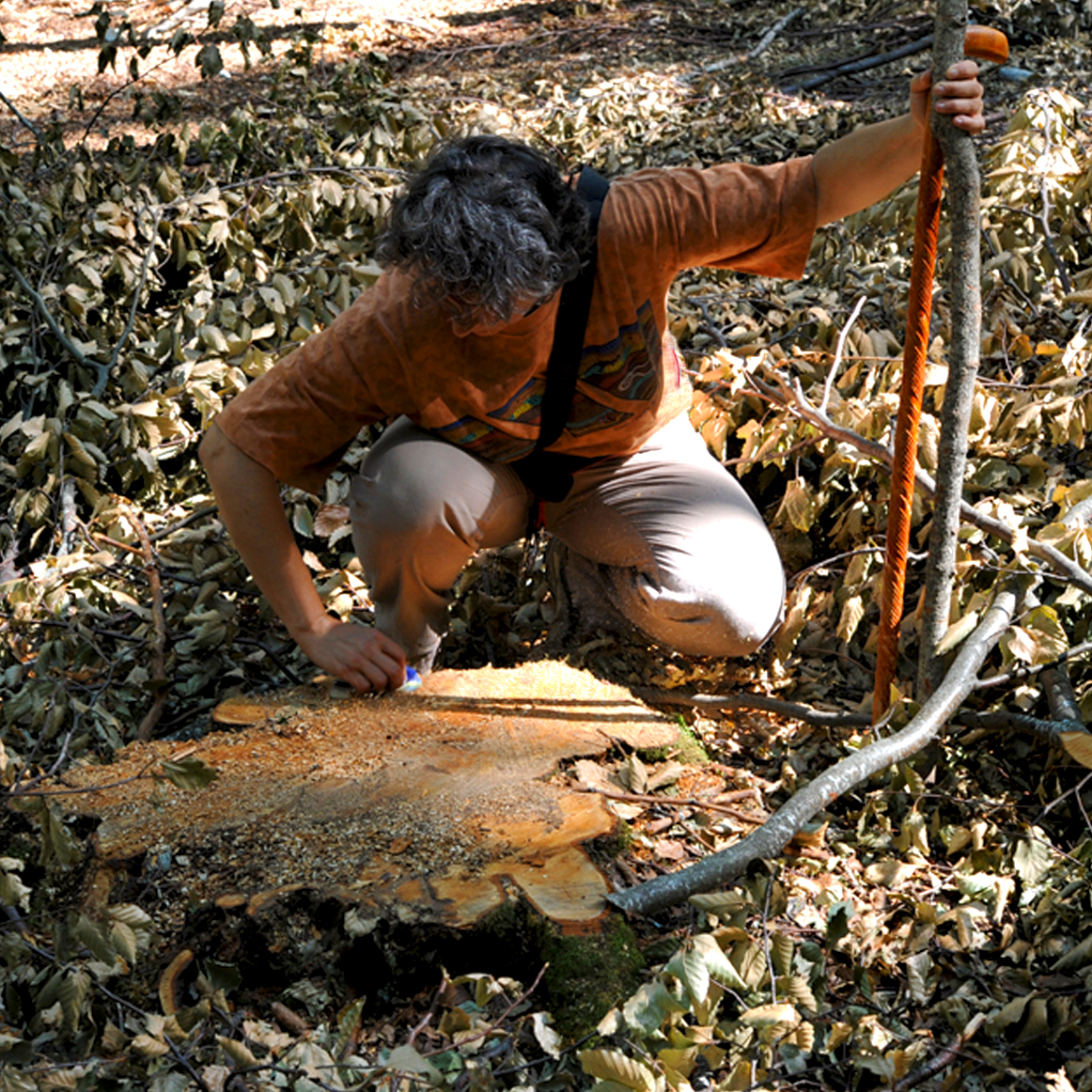
You have also worked in unconventional places and through performances, from the Sirente Velino mountains to Buchenwald. What changes when an artwork leaves the protected space of the gallery and encounters a real place, with its history and memory?
I have spent a great deal of time in Sirente Velino National Park, but something extraordinary happened after the earthquake in L’Aquila.
While walking through the beautiful beech forest, I suddenly stopped and looked at the bases of the trees that had been cut down. I was overcome by a powerful emotion. I knelt down and began to clean that wound. That was how Taglio del Bosco began.
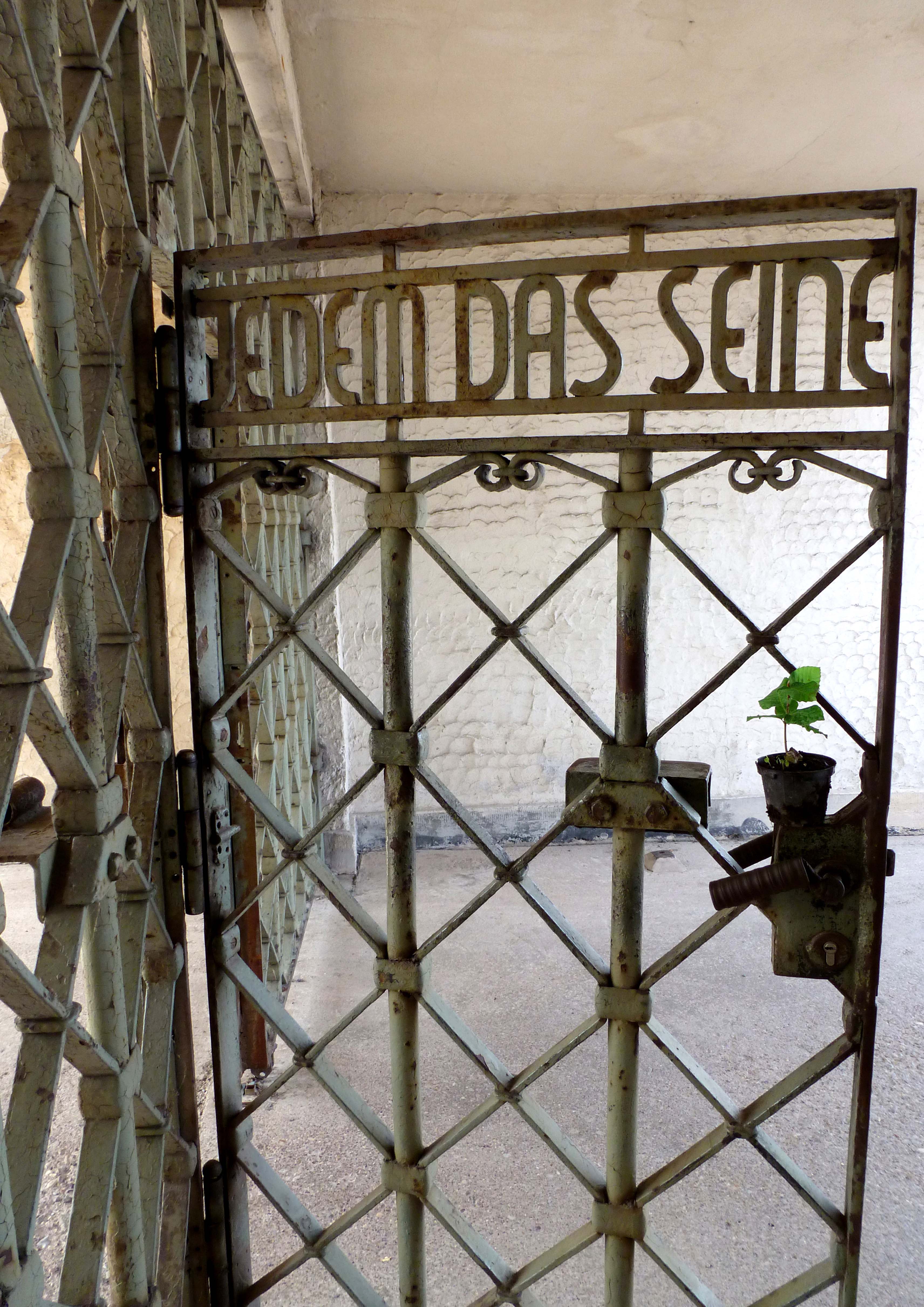
While researching the beech tree, I discovered that Buchenwald means “beech forest.” To build the concentration camp, countless trees had been cut down. Because my own family history is connected to the persecution of Jews in Italy, I decided to bring two young beech trees, grown from seeds collected in the Sirente Velino forest, to Buchenwald.
These two emotionally powerful and intense experiences could only take shape in the places themselves, places charged with history and memory, and therefore sacred.
In Due ma non Due, created through a long distance collaboration with Margherita Taticchi during lockdown, distance became a creative space: words, photographs, drawings, embroidery and voices transformed into a shared work. What can happen artistically when we relinquish, at least in part, the idea of the individual author?
At the beginning of the pandemic, I received a voice message from Margherita. She was alone at home and visually impaired, and asked me if I could read her Mariangela Gualtieri’s poem 9 marzo 2020.
From that moment until May 3, 2020, I never stopped reading her one poem a day and sending it to her.
Gradually, the poems we exchanged every day were joined by thoughts, comments on events and photographs. Through this strange correspondence, facilitated by WhatsApp, an intimate relationship slowly emerged.
We discovered one another, our differences, our similarities. We met each other in a new way. But what I felt most strongly was that we encouraged, supported and, in a sense, cared for one another.
When the pandemic ended, we felt a desire not to let this precious moment disappear. Each of us processed, translated and transformed it in her own way, turning it into words and images.
From this came a book and a four handed installation, DUE MA NON DUE.
You also founded MESIA SPACE arte contemporanea, a space born from collaboration between artists. How important is it for you not only to create artworks, but also to create places and communities in which art can happen?
The desire to enter into dialogue, exchange ideas and bring creative experiences into conversation with one another has always been a deep necessity for me.
Mesia Space arte contemporanea, which I run with Alessandro Riva, my life partner, is a dream we wanted to bring into existence since our adolescence. Today, it continues to grow together with a community of artists and people passionate about art.
There is an old African fable about a great fire that breaks out in a forest. All the animals flee in terror. When they reach an oasis with a lake, the lion sees a hummingbird collecting water in its beak and flying back towards the fire, again and again.
Exasperated, the lion roars: “Where do you think you’re going?” The hummingbird replies: “To the lake. I collect water in my beak and carry it to the fire.” The lion, irritated, says: “Are you crazy? You don’t think you can put out a gigantic fire with four drops of water!” The hummingbird answers: “I am doing my part. Now you do yours.”
And so, little by little, all the animals in the forest follow its example, including the lion, who has learned a great lesson: one drop in the ocean is already something; many drops together are something more.
Perhaps today we can no longer turn back. But even a small movement, a small action, something that reduces suffering and creates a little more hope, is what we can still cultivate as human beings.
We may already have reached the point of no return, but we can still nourish the small things: being together, caring for one another, creating places where people can gather.
And we can still dissert, a word that derives from serere, meaning to weave, but also to loosen: to create spaces, openings in the fabric of the weave, and to continue creating stories so that they can be told. Because despite everything, human beings are political and poetic animals, and capable of empathy.
Is there a question that keeps returning in your work, one to which, after all these years, you still have not found an answer?
I believe the core questions I began with have changed over time through experiences and events.
New questions have gradually emerged, with nuances and forms that were previously hidden, through a continuous process of change and deepening. I do not think, and I do not wish, to arrive at an absolute, exhaustive and final answer.
Many young artists today feel pressured to build a career quickly, to be visible on social media, to produce constantly and to adapt to the expectations of the art system. What would you say to a young artist who feels she has her own path, but does not yet know where it will lead?
I would answer the young artist with the poetry of Antonio Machado:
Wayfarer, your footsteps
are the road and nothing more;
wayfarer, there is no road,
the road is made by walking.
By walking, the path is made,
and when you look back,
you see the road that never again
will be walked upon.
Wayfarer, there is no road,
only trails upon the sea…
Do you think an artist should seek out their audience, or, on the contrary, have the courage to continue working even when no one seems to be listening yet?
Each of us, with our own particular way of walking the path of life, can choose, through our own “art”, whatever form it may take, to take the risk of becoming free.
And finally, a much less philosophical question: wine or beer?
At a candlelit dinner, with friends, or during a festive lunch, I would definitely choose wine. But by the sea, beneath an intense sun, an ice cold beer can be a wonderful pleasure. And then there is tea, for reconnecting with life, or freshly squeezed orange juice for a little extra energy. I would always add plenty of water, and never commercial fruit juice.
Perhaps this question, too, has a philosophy hidden beneath the surface.

 Nessun prodotto nel carrello.