
In this interview, Paola Romoli Venturi speaks about her artistic journey, her creative process, the relationship between space, memory, and perception, and the role of contemporary art as a place for reflection and dialogue.
Your artistic journey has developed through different forms of expression, including installation, sculpture, painting, video, and performance. How has this interdisciplinary approach shaped your artistic language?
Completely. Connecting ideas, forms of expression, and actions in order to tell a story across different media is a constitutive part of my figurative and performative language. The interdisciplinary approach helps to involve the audience, who both observe and take part.

Transparency, light, and perception are important elements in your artistic research. What fascinates you about what can be seen, hidden, or revealed through an artwork?
Transparency is a constitutive element of my work, both physical and mental. A transparent or mirrored installation or sculpture that reflects light draws the viewer into the artistic device. Once the viewer has entered physical transparency, mental transparency is activated, encouraging reflection and a sense of freedom in front of the work.
Physical transparency is that of spaces, installations, and sculptures that lead viewers to step inside, drawing closer and closer with their gaze until they are captured by the work.
Mental transparency means approaching things freely and neutrally, in order to arrive at a new idea.
Many of your works create immersive experiences where the viewer becomes part of the artistic environment. How important is the relationship between the artwork, the space, and the person experiencing it?
The relationships between artwork, space, and person are very important, because they create the spark that makes a work contemporary.

How does a new artwork begin? Does the process start from an idea, a social reflection, a place, a material, or an emotion?
My work usually begins with a news story. In 2008 I began to define the idea of “instant art.” I start from current events and transform them into images, sensations, and reflections that rescue the subject from the fate of the news the media present every day, news that stays in our personal memory for a very short time, pushed aside as it is by other news. Art becomes a sounding board that vibrates through time.
I believe that, with public commissions and patrons all but gone, the only way to address social and public issues is to follow the news, identifying stories that, connected to one another and to the social fabric, can tell the story of the contemporary.
Then, of course, there is an idea, a reflection, a place, a material, an emotion, and many other elements that make up the project, which usually begins with the writing of a concept or a poetic text, or a nursery rhyme, that then becomes part of the project itself.
Your artistic practice often combines different elements such as images, sounds, materials, and spatial interventions. How do you create harmony between these different languages?
Balance among the languages is achieved through mental transparency in the creative phase. If the idea is clear, and you know where you want to arrive and above all where you want to lead the audience’s reflection, the various parts connect in a natural and surprising way. Of course, there is also experience, knowledge of different artistic techniques, and the ability to perceive space, light, and sound. Sound includes silence, words, and gesture. All of this creates a space that is “natural” and at the same time engaging.
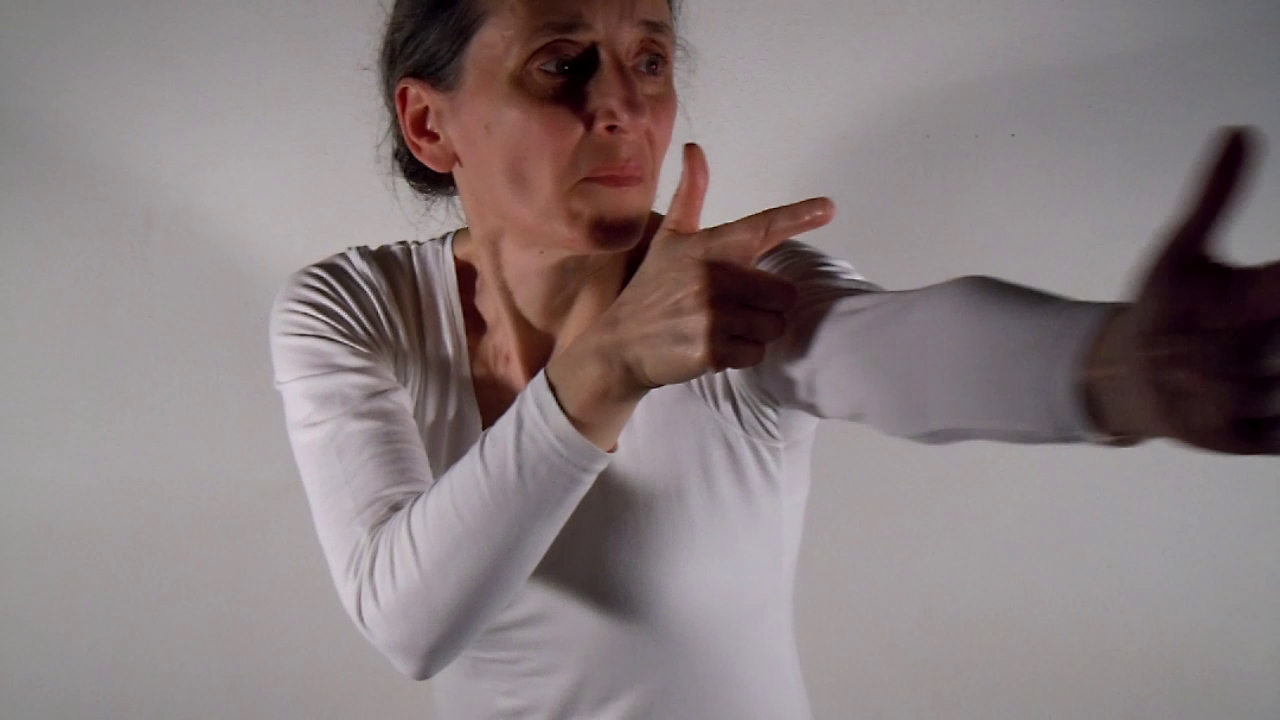

- La Pace è stanca, 2025. Sound performance for the festival i Tramonti di Tinia, Sutri. Photo: Flavio Ianniello.
Memory and human experience are recurring themes in your research. How do personal and collective memories influence your creative process?
Collective memory is the humus, the ground in which the personal memory of the artist, and above all of the people who experience the work, takes root.
The creative process is not influenced by memory. It is a flow in which memory, history, and design connect to bring the work into being.
Your installations often enter into dialogue with specific locations and their histories. How does a place influence the meaning and development of an artwork?
Place is structural to the project. I need to know the history of the place, whether it is a city, a house, a gallery, or an outdoor natural setting. Site visits and measuring the place and space are important to me. I create site-specific performative installations, for which I draw floor plans and build scale models in order to design space, light, sound, movement, and flow. I design container and content in synergy.
Many of your projects address social and environmental themes. What role do you believe art can play in making people reflect on contemporary issues?
Art can shed light on the political question, the social or environmental theme. It can stimulate reflection by bringing it to light. As I said, art becomes a sounding board that vibrates through time. And so the news story at the root of the work reverberates through time. Through art, the social or environmental issue is brought back in the future and made part of history.
Moreover, all my projects evolve over time, such as PTV_PaolaTrashVotex, which began in 2012 and has developed over the years through numerous site-specific installations (ISOLE_PaolaTrashVotex 2012/2026, ISOLA lungo mare di Roma 2013, ISOLA di Torano 2015, ISOLA dell’Aventino 2024, ATTENZIONE questa è un’arma letale 2013/2022, Il luogo del delitto 2016/2024). It was also exhibited in the show Germogliati semi at the Orto Botanico dell’Aquila. The project, which deals with environmental themes, unfolds through the collective-reflection performance Salva la tua Balena! (“Save Your Whale!”, 2013/2024), in which the ISOLE sculptures are made from endogenous plastics.
Throughout your career, you have explored new forms of artistic expression and interaction with the public. What continues to inspire your research today?
The future, the past, and the contemporary stimulate my research. It is the connection between history, which repeats itself in forms, and technology, which changes over the centuries while repeating forms of creativity inherent in the physical and mental DNA of nature and humanity. As they collide, they create new relationships and reactions.


- ISOLA di Torano, 2015. Site-specific installation, Piazza Ammiraglio Torano, Carrara. Tarlatan, endogenous plastic consumed by the inhabitants of Torano, light. Photo: Marco Adinolfi.
When visitors encounter your work for the first time, what kind of experience, emotion, or reflection would you like them to take with them?
I like the idea that an opinion can be stirred, that people look at themselves in the mirror, look themselves in the eye, searching for their own opinion on the issue raised, through the colors and forms of art.
Looking back on your own artistic journey, what would you like to pass on to young artists who are searching for their own voice and path?
First of all, be sincere and centered. Travel, build relationships, observe, and never lose sight of yourself as part of an “us.” Walk while standing still; stop in order to look. Talk to yourself and to others. Listen.
A more personal question: Wine or beer?
Wine. But I prefer water.
Photo captions
01 La Pace è stanca, 2025. Sound performance for the festival i Tramonti di Tinia, Sutri. Photo: Flavio Ianniello.
02 WE, 2016. Video frame from performance.
02bis WE, 2017. Site-specific installation for the event Diritti in transito, Ex Dogana, Rome. 16:9 video, adhesive tape, floor drawing. Photo: Marco Adinolfi.
03 ISOLA di Torano, 2015. Site-specific installation, Piazza Ammiraglio Torano, Carrara. Tarlatan, endogenous plastic consumed by the inhabitants of Torano, light. Photo: Marco Adinolfi.
04 Studio image of Paola Romoli Venturi, Traspaquadro on the work table, 2017. Photo: Marco Adinolfi.
05 MEMORIE: MAIN MEMORY, BY HEART, PAR COEUR., 2016. Sculpture, site-specific installation in Statuario Carrara white marble, Rosso di Francia Languedoc marble, engraved text, 316 Super Mirror stainless steel. Photo: Marcello Leotta.
06 AD PINEAM, 2016. Site-specific installation, Piazza Santa Maria in Cappella, Rome. Tarlatan, lights, cut-out masks for shadow effects. Photo: Marco Adinolfi.

 No products in the cart.