Art, Memory, Vulnerability and the Traces We Leave Behind
Interview by Jane Katharina di Renzo | 23 October 2026
1. The Origins of an Artistic Inquiry
Your artistic practice encompasses painting, photography, installation and writing. Looking back, do you recognise an original intuition that has continued to guide you across these different forms of expression? What is the question you continue to ask of your work today?
I recognise an immediate need to express the emotion triggered by an external event. To achieve this, I choose the medium best suited to my purpose, the one that allows me to come closest to my own truth. It may be the language of photography, painting or writing. Part of my natural disposition lies in my ability to sense which medium is most congenial to me.
I ask myself whether the feeling I seek to convey also reaches others. I believe that art, beginning as something personal and intimate, should ultimately become a collective experience.
2. The Places That Inhabit Us
You were born in Sicily and live and work in Ravenna, having spent considerable time travelling through distant countries and cultures, particularly India and China. How much of the places we encounter remains within us, transforming the way we see the world long after we have left them? And to what extent do we, in turn, transform those places through our own memories?
For me, travelling is an exchange of energies. I was born in Sicily and have lived in Ravenna for more than sixty years. Sicily lives in my soul; Ravenna lives in my heart. My artistic education took place in Ravenna, yet my Sicilian identity is like a second skin.
My journeys to other continents have left traces that no one can ever take away from me: colours, emotions, pietas. These traces have enabled me to create a series of paintings that, whenever I look at them, transport me back to those places.
Memory, for example, is what I carry with me from my stay in India, where flowers are the only beings that never go hungry: strong, fleshy, colourful and exuberant, they flaunt their beauty without embarrassment.
Then there is China, with its inks, brushes and papers. And Japan, with its harmony, its gardens and its ikebana.
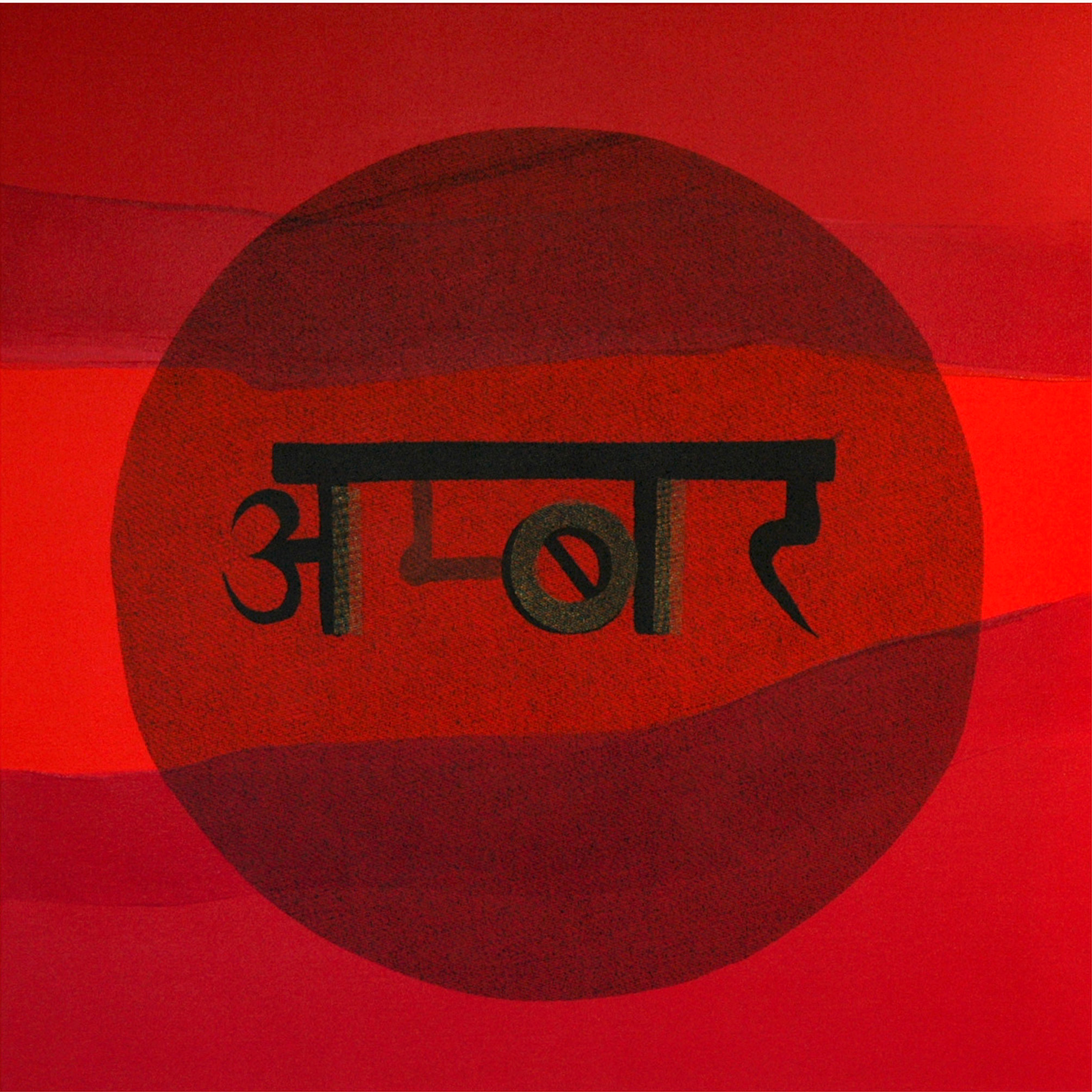
CERCHIO, acrilico, tarlatana su tela cm100x100 – 2006
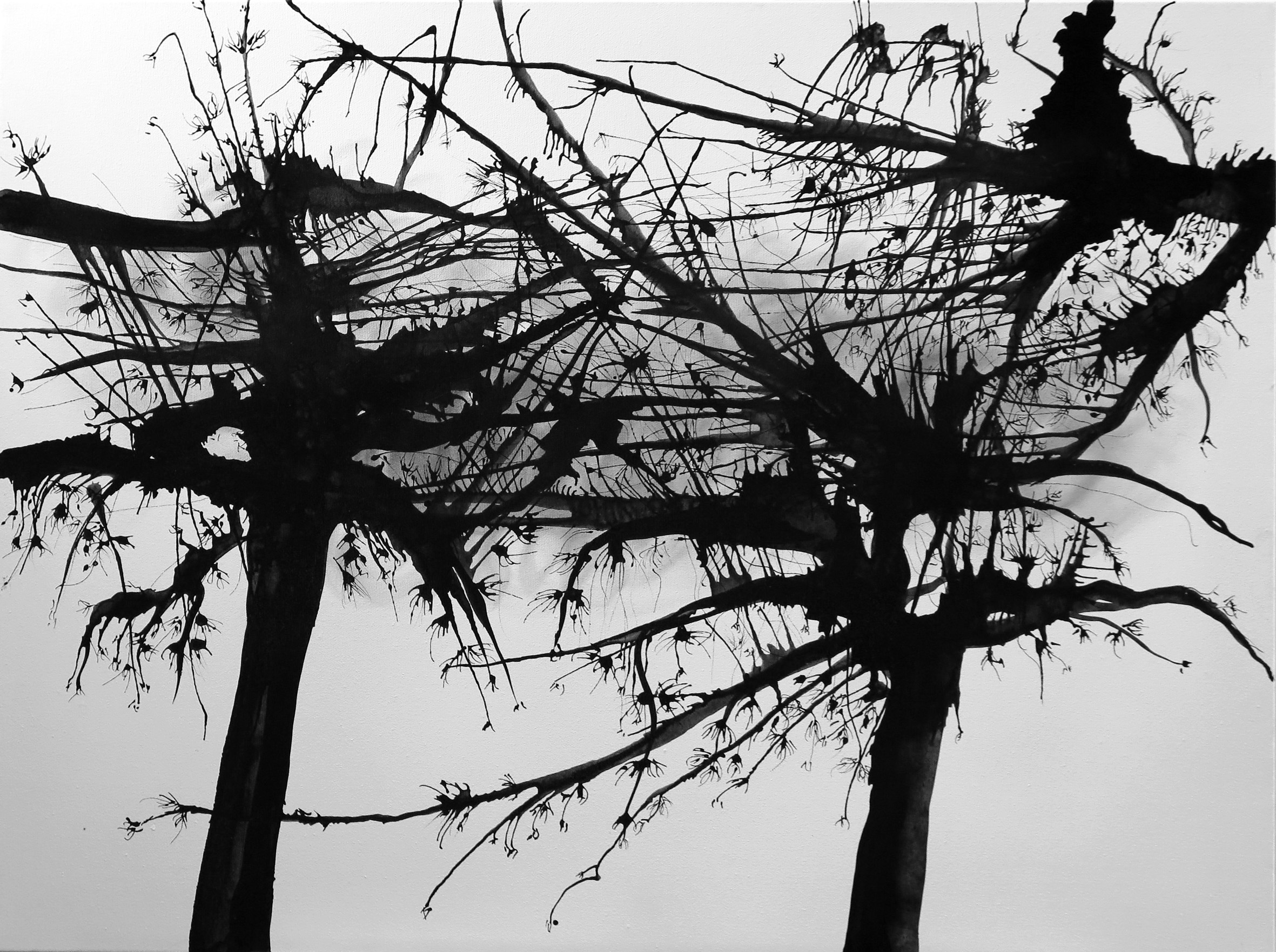
NOI ERAVAMO PINI, acrilico, grafite su tela cm. 60×80 -2017
3. Memory as Material
In your work, memory seems to be more than a return to the past. It is a presence that changes, resurfaces and assumes new forms. Does creating mean preserving a trace, or transforming it, allowing it to become something that did not previously exist?
Working with memory is another dimension of my practice, one that I often preserve behind a veil of tarlatan. Memory brings things into the present, which means re-examining what reality takes for granted. Memory is what leaves the wound visible.
Mental processing begins with memory. In my work, this also takes concrete form in the representation of a leaf or its imprint, or in tracing the written signs of other peoples and transforming them into pure painting.
It is the sense of loss that persistently compels me to bring the trace, the memory, to the foreground.
4. Continuity and Change
In his text devoted to the rooms that have shaped your artistic journey, Claudio Spadoni identifies a thread running through your different techniques and periods. Do you recognise yourself in this interpretation? And how important is it for an artist to recognise a sense of continuity without relinquishing the contradictions and transformations that keep an artistic inquiry alive?
Yes, I recognise myself in Claudio Spadoni’s interpretation. The thread running through my artistic production is its poetic sensibility and compositional rigour.
I enjoy experimenting with different materials, including paper, tarlatan, lead, iron and barbed wire, as well as a variety of techniques. I could never paint alone.
5. Beauty in the Face of Violence
In your mandala of 123 roses intertwined with barbed wire, the delicacy of the flower encounters the brutality of violence against women. It is an image of great symbolic force, in which beauty does not erase pain but makes it visible. How can suffering be given form without reducing it to an image that is merely contemplated? And what responsibility do you feel as an artist when choosing to confront a collective wound?
In this work, made with barbed wire, I wanted to represent the psychological tension and violence that sometimes lie hidden behind the feeling of love.
The rose is the quintessential symbol of love. In this floor installation, the roses form a spiral: the spiral of violence. I created this work with physical as well as emotional suffering, driven by the desire to make something that would not simply be contemplated, but that might, I hoped, encourage reflection. I am aware that art cannot change the world.
Confronting a collective wound is a tremendous responsibility. I know this. Yet I have done so on several occasions: addressing war, violence against women and violence against nature.
6. The Face and What Remains Hidden
In Dietro il volto, l’universale mistero del velo (Behind the Face, the Universal Mystery of the Veil), photography becomes a means of questioning identity, visibility and the mystery of the other. We live in an age in which we are constantly encouraged to show ourselves, tell our stories and make our private lives public. What value does the right to remain partly invisible retain today?
Today, it is no longer possible to remain invisible. We are all catalogued, and I find this entirely devoid of value.
The veil is a contentious subject, entangled with religion, politics and numerous power relations. My large-scale photographic works explore the mystery of the veil and the different ways it is worn. What matters is not the face, but the attitude, the condition of the veil, its allure and its ambiguity.
These are faceless figures that nevertheless dominate the scene, silent and hieratic. Women portrayed within the very air that brushes against them. Prisoners of their own intangible boundaries, yet free from every gaze. Hidden, transparent and seductive. This is the ambiguity of the veil.
Behind the elegance and dignity of the veils I have photographed lie different identities: the wealthy woman, the street sweeper, the mother, the Romani woman, the washerwoman, the nun, the bride. Each wears her own veil, never the same, never displeasing, always regal.
The veil is a talisman. Its weave is exceedingly fragile, yet its mystery is immensely powerful. My interest in this subject is rooted in childhood memories of Sicily, among maternal figures covered in long shawls.
7. Fragility as a Form of Knowledge
In your practice, fragility often emerges as a condition to be listened to rather than simply overcome. Do you believe there is a form of knowledge accessible only through vulnerability? And what can we see when we accept that we cannot always remain in control?
Fragility is a signal to be listened to because it is truthful. Only in this way can it be overcome.
I believe that there is a form of knowledge accessible only through vulnerability. Vulnerability is the method, the price we pay to arrive at knowledge. In my view, fragility is the condition that makes other forms of knowledge possible. To listen to it is to open a passage.
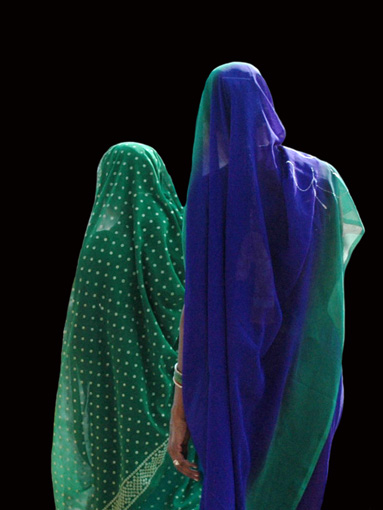
AL TAJ MAHAL, stampa fotografica su su forex, cm.120×90 – 2011
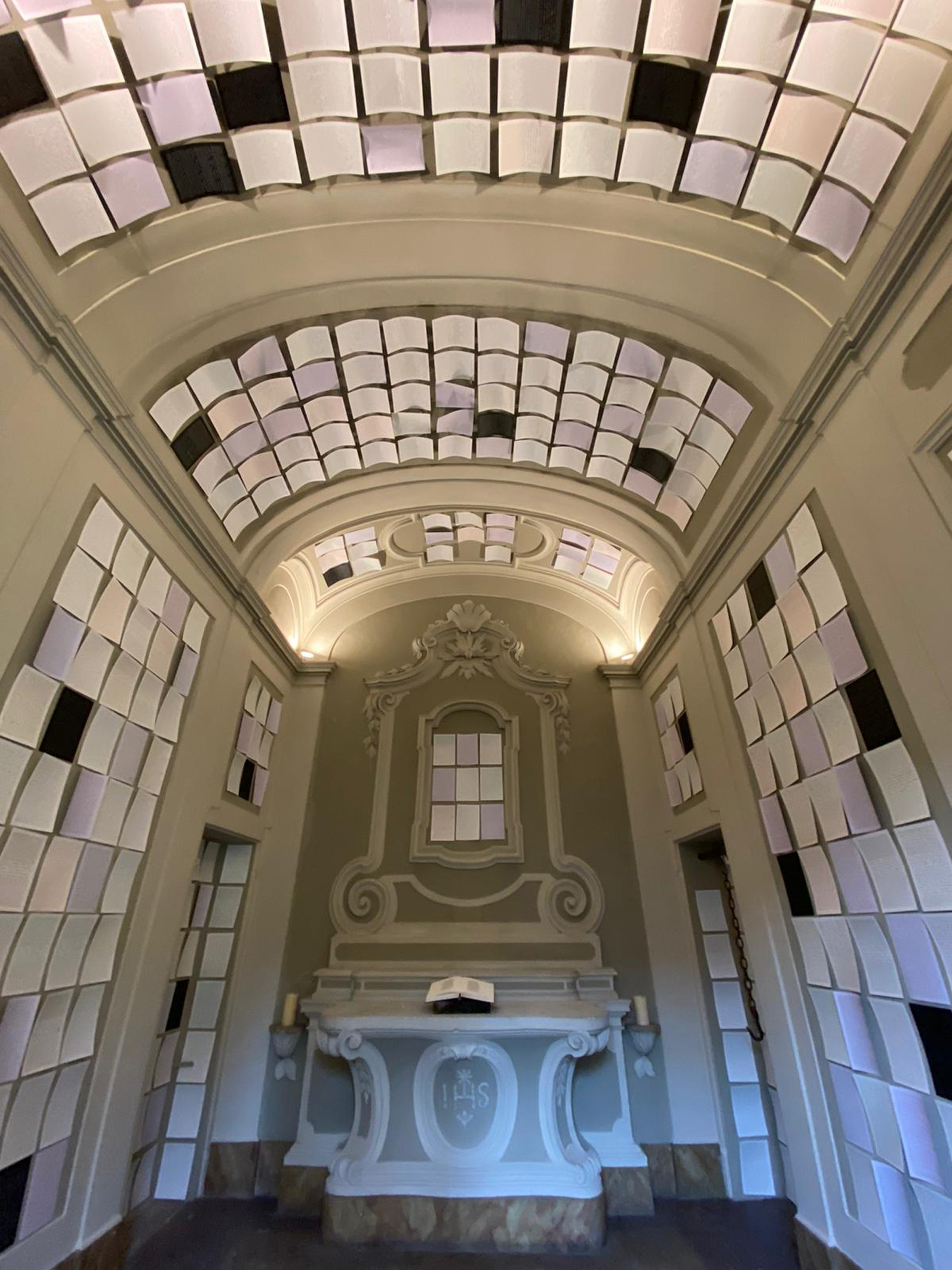
QUANDO È DANTE A DARE I NUMERI, installazione grafica a parete di 408 schede (30×21 cm cadauna) eseguite con 16 penne stilografiche e 16 inchiostri differenti sulla numerologia dantesca – 2021, Cappella di Palazzo Baronio, Ravenna
8. Wounded Nature
In Sentimento della natura (A Feeling for Nature), images of the charred remains of a pine forest evoke a wounded landscape. In the face of environmental destruction, do we risk losing part of our own capacity to recognise ourselves in nature? Can art help us recover a relationship that modernity has progressively weakened?
I do not know whether art can help us recover our relationship with nature. What I do know is that the loss of a landscape is a laceration, a wound, a violation of that divine art which is nature.
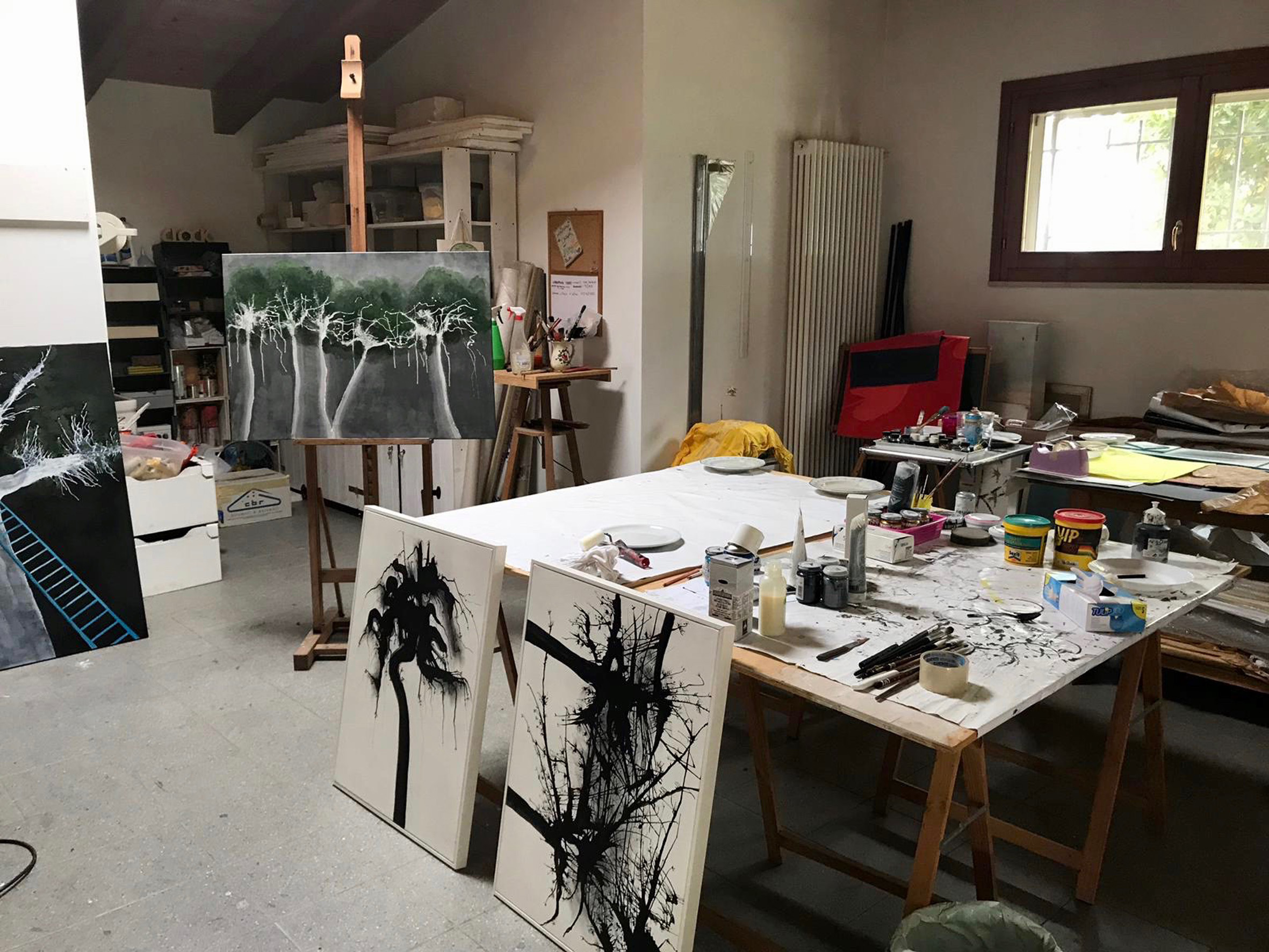
In my works devoted to wounded nature, I seek to represent a real tragedy: the devastating role of human beings in their relationship with the environment. Using black and white, I depicted a pine forest ravaged by fire, where the pines, unwitting victims, are transformed into twisted spectres.
In this personal archive of the soul, I wanted, in a sense, to catalogue these monuments that no longer exist, while also immortalising, with astonishment and emotion, the devastation inflicted upon that natural world.
9. Encountering Distant Cultures
Your journeys to India and China have left profound traces in your visual language: ideograms, scripts, colours and formal abstractions. What happens when we approach a culture that we cannot fully understand through our own frames of reference? How can we distinguish an authentic encounter from a simple fascination with what is different?
Approaching another culture is an extraordinary enrichment that leaves profound traces. I approached these countries through their writing, to which I dedicated a series of works and subsequently an exhibition at UNESCO headquarters in Paris, held on International Women’s Day and entitled Chindart (China, India, Arabia).
Fascination with another people, another culture, can be easy and immediate. Encounter is more difficult, and you recognise it over time precisely because it remains within you. You feel the need to delve deeper, to study.
Fascination is fleeting. An encounter does not pass.
10. When the Sign Becomes an Image
In your work, scripts and ideograms can lose their original communicative function and acquire a new pictorial autonomy. When does a sign cease to be something to read and become something to feel? And how important is it to your practice that viewers can experience a work without necessarily deciphering it?
In these works devoted to the writing systems of other peoples, I seek to convey the extraordinary harmony between the linguistic signs that form the foundations of three very different civilisations surrounding the Western world: China, India and Arabia.
Graphic signs become traces engraved in memory. I have given writing an aesthetic and contemplative value, treating the graphic sign no longer as a mere means of communication, but as an end in itself and as an instrument of pictorial action.
In other words, writing becomes pure painting.
I therefore believe that viewers can experience the work without necessarily having to decipher it.
11. The Dialogue with Poetry
Poetry runs throughout your work, from your reflections on Emily Dickinson to the publishing project Biblioteca Minima, created in collaboration with various poets. What can poetic language express that an image cannot reach? And, conversely, what can an image reveal that words risk explaining too explicitly?
Painting and poetry can interact in a kind of aesthetic symbiosis.
I have always felt the need to move within this territory, seeking to draw from poetry those elements of stimulation that, through free associations, guide my hand or shape an installation, as I did with Nella stanza di Emily (In Emily’s Room).
It is an open-ended dialogue. Painting and poetry are sister arts, even though each remains autonomous.
The Biblioteca Minima project pairs an unpublished poem by a living poet with an original graphic-pictorial intervention of my own.
I select each poet on the basis of a personal encounter, guided by the mutual esteem and friendship that develop between us. In this way, each collaboration becomes part of an authentic artistic journey, preserving forever the memory and the affinity born of that encounter. The idea for this project came to me after meeting Mary de Rachewiltz, Ezra Pound’s daughter. I recorded that encounter indelibly in the first issue of Biblioteca Minima.
Poetic language reveals what is absent from the moment, the invisible. An image reveals everything in an instant. It places the thing itself before us; no words are needed, only our own capacity to feel.
12. The Value of Silence
Today, we are immersed in a continuous flow of images, information and interpretations. Art, too, is often expected to communicate quickly and make itself immediately understandable. How important is it, by contrast, to leave room for silence, ambiguity and what cannot be resolved through explanation?
Yes, silence holds great value for me. Too many images and too much information lead to nothingness. In my work, I strive for rigour, clarity and silence. Painting silence is difficult, but it is what I seek to do.
13. Pietas as Responsibility
In Pietas, material, colour and symbolism open up a space for contemplation and reflection. The word pietas carries several meanings: compassion, respect, devotion and responsibility towards others and towards what came before us. Which of these meanings resonates most deeply with your sensibility? And how can pietas become an active force, capable of guiding our relationship with the world?
Pietas looks in two directions: backwards, towards those who came before us, and forwards, towards those who will come after us. Perhaps it is what compels us to do something well, even when no one is watching.
Pietas as responsibility? Certainly, towards others and towards what came before us. When I paint, I feel a profound responsibility towards the masters of the past. They are present in my mind, even as I try to listen to my own voice, to what I feel.
14. The Artwork and Space
The transition from painting to installation has changed not only the way you create your work, but also your relationship with those who move through it. When a work occupies a physical space, the viewer is no longer simply standing before something, but becomes part of a situation. What changes in this relationship for you? And what can happen within an exhibition space that would not happen in front of a single image?
In an installation, the work is the space itself. You enter it and move through the work. I love architecture and need to feel in harmony with it. Moving from painting to installation therefore came naturally to me.
My works are rooms. I have created La stanza di Emily (Emily’s Room), La stanza di Ulisse (Ulysses’ Room), La stanza dell’uovo allo specchio (The Room of the Egg in the Mirror), La stanza “Noli me tangere” (The Room “Noli Me Tangere”) and La stanza “Quando è Dante a dare i numeri” (The Room “When Dante Starts Counting”).
When you stand before a painting, there is a centre and a sense of stillness. In an installation, you move beyond the stillness of representation. You walk through the work, and it changes with your point of view.
Space tells a story.
15. The Artist and Her Time
You began your artistic journey in the late 1970s, witnessing radical transformations in the art world and in the very concepts of painting and the artwork. Which changes have genuinely transformed the way you work? And what has remained essential, beyond artistic movements, critical definitions and market expectations?
My way of working changed after my studies at DAMS in Bologna.
The in-depth study of contemporary art and my visits to exhibitions in the 1970s called my entire body of work into question.
What has remained essential, beyond everything else, is my approach to creativity: truthfulness in what I do, pleasure in working with materials, and a tenacious determination to pursue my own ideas, even when they fall outside current trends, critical discourse and the market.
The art market is accessible to only a few, and I do not know on what grounds they deserve that access.
16. The Freedom Not to Belong
The contemporary art world often seeks to classify artists according to their visual languages, generations and affiliations. Your practice, by contrast, seems to have developed through a free interweaving of techniques and references. How important is it for an artist to resist categorisation? And does this freedom come at a price?
Yes, mine is a free-ranging journey in which I openly question painting, installation and photography. I am not interested in being placed within a category, even if this can put me at a disadvantage.
I do not run the risk of producing works simply to earn a definition. This freedom is priceless. As Picasso once said: “There is nothing more vile than copying oneself all one’s life.”
17. Art in the Age of Artificial Intelligence
Artificial intelligence is transforming the way we produce and consume images, challenging concepts such as authorship, originality and the creative gesture. In this landscape, where do you recognise what makes a work of art irreducibly human? Is it lived experience, vulnerability, intention, materiality, or something we have not yet learned to define?
Artificial intelligence is radically transforming our creativity and the way we experience images. It would be foolish not to acknowledge this.For me, an image is the trace of a process. Behind every work is an eye that has learned how to see and a skilled hand capable of bringing an idea to life.
With artificial intelligence, an image can be reproduced without having been experienced from within. You describe it, and you obtain it. Whereas, in manual practice, the limitation lies in what one knows how to make, with AI the limitation lies in knowing what to ask for.
Walter Benjamin wrote that the work of art loses its aura when it becomes reproducible. I cannot imagine what he might write today! The art that interests me is the kind that makes me use my hands, the kind that compels me to respond to the material and to my own intention.
18. The Advice You Will Never Find in a Handbook
What advice would you offer a young artist trying to find their own voice in an art world that is competitive, fast-moving and increasingly shaped by visibility? And, looking back on your own journey, what mistake would you encourage them not to be afraid of making? Above all, perhaps, what should they have the courage not to follow?
It is difficult for me to give advice. I think young artists today are far more alert and quicker to learn the rules of the art world than I was at their age. Nevertheless, I would advise them to learn their craft before searching for a language of their own, not to fear being impossible to classify, and to follow their dreams without feeling the need to be original at all costs.
19. Life Beyond the Artwork
Artistic practice demands concentration, solitude and a constant willingness to question oneself. Yet there is also a life that exists beyond the pursuit of art, made up of simple gestures, encounters and everyday pleasures. What restores a sense of lightness when you step away from the studio?
Without concentration and solitude, I would not be able to produce anything. For me, these are indispensable conditions, although I wish I could question myself less. That is why my studio is in the countryside, surrounded by nature and tranquillity. Beyond the studio, the most extraordinary source of lightness is being a grandmother to a six-year-old girl.
20. What Remains
If someone were to leave one of your exhibitions carrying away just one thing—not necessarily an image, but perhaps a question, a sensation or a different way of looking at the world—what would you hope it might be? And after so many years of artistic inquiry, what are you still trying to understand?
I always find it interesting to hear people’s comments as they leave exhibitions. I would like them to carry away a feeling. What am I trying to understand? Why I cannot help making art. Why I have been afflicted by this persistent inner drive.
And Finally, a More Informal Question
On an evening spent without talking about art, would you choose a good glass of wine or a beer? Where would you like to be, and in whose company?
A beer by the sea, in the company of my cat, Sofonisba.
Want more?
Interview in Original Language Italian


 Nessun prodotto nel carrello.
