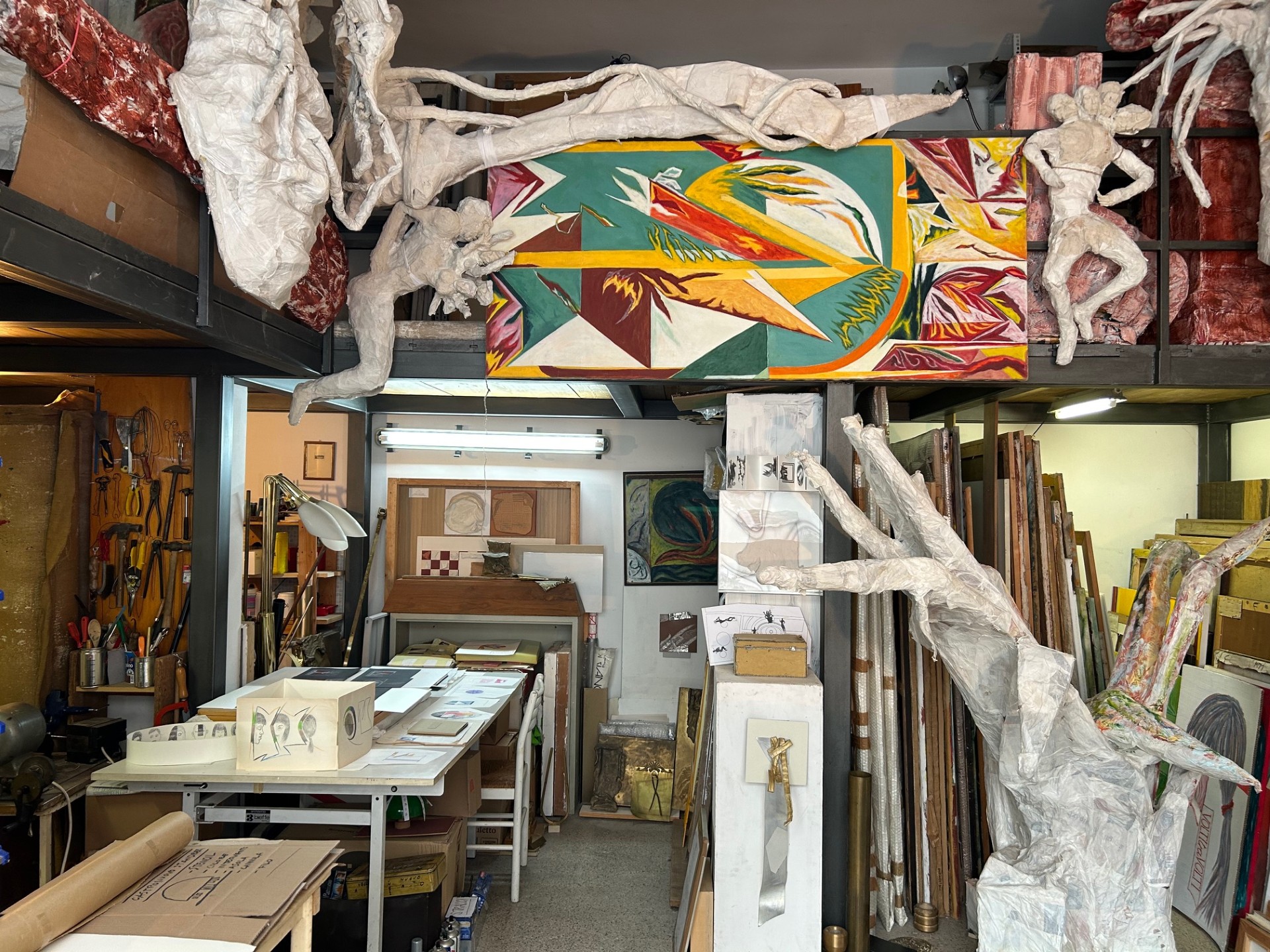
Art as a Form of Encounter
A Conversation with Enrico Pulsoni on Matter, Memory, Theatre and the Future
1. Before the Artist
If, for a moment, we were to put aside everything we know about Enrico Pulsoni, the exhibitions, the works, architecture, theatre, and teaching, and return to the young man who did not yet know what form his life would take, what do you remember about that first need to create? Was there already something you could not express in words?
I was born in the countryside, and in the farming world, as in the old theatre companies, everyone has a role, including children, in the daily work. Contributing through simple tasks, removing stones from lentils, feeding small animals, and so on, gave me the manual skills that later allowed me to express myself through words and actions. I think that, in developing her innovative educational method, the “city woman” Maria Montessori may actually have drawn inspiration from the farming world.
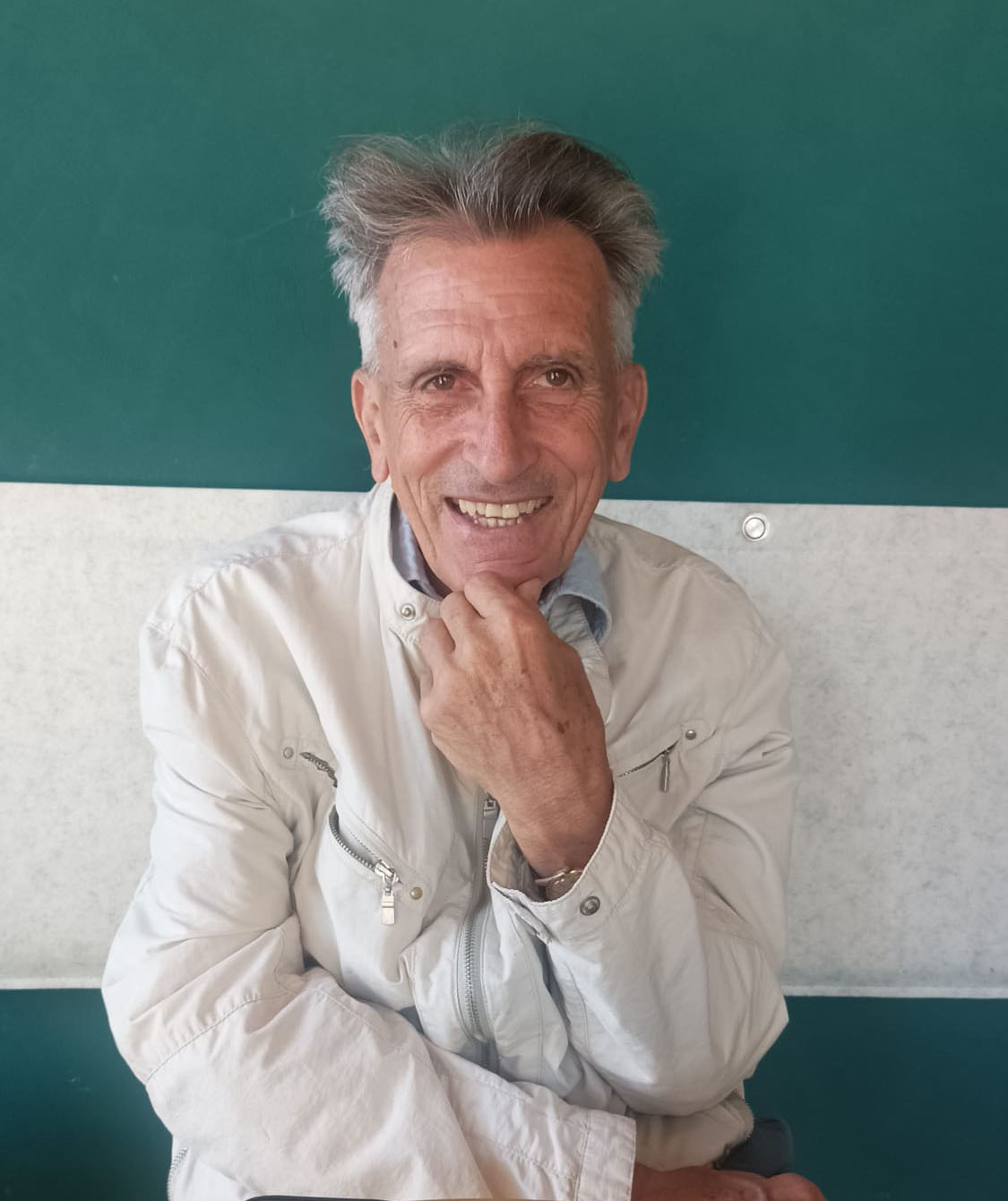
Enrico Pulsino, Selfportrait
2. A Life Without a Single Discipline
Looking at your career today, it is difficult to define you simply as a painter, sculptor, scenographer, or architect. Have you ever felt the need to choose a definition? Or do you think that precisely the refusal of a category has been one of the conditions of your freedom?
The manual ability I mentioned, together with the capacity to conceive something and then actually realise it, found its synthesis when, through a high-school classmate, I became involved with the Gruppo Altro in Vicolo del Fico. Within the group, everyone had the right to speak, to make proposals, and everyone had to contribute to the realisation of the various theatrical and exhibition productions, even performing on stage.
Essentially, we had to inhabit a space and make it come alive in all its possible forms: constructions, colours, sounds, movement, and everything else one could imagine. The term Gesamtkunstwerk, a total work of art, aptly describes what happened within Gruppo Altro, whose subtitle was Lavoro Intercodice, or “Intercode Work.”
To clarify: my work consists of telling stories, and each story requires a specific language, and more precisely, a different material. It is not a question of freedom, but of making the story being told more authentic and differentiated.

3. Encounters
You have spoken of encounter and dialogue as fundamental conditions for experimentation. Looking back at your artistic life, which encounters truly changed the direction of your work? And is there someone whose presence continues to live within your work, even after many years?
One of Gruppo Altro’s performances was Incontri, Encounters, freely based on the writer Helmut Heissenbüttel: an analytical description, through diagrams, of the encounter between two people. The most interesting diagram was the one in which the two protagonists each found themselves entangled, with one arm caught inside the other’s sleeve. Encounters have to be seized when they present themselves, because life is something that happens while we are busy thinking about something else.
My family, having no preconceived notions or prejudices towards the worlds of art and performance, made things much easier for me, and I have always sought out opportunities for new encounters.
4. Achille Perilli and Freedom
Your experience with Achille Perilli and the Gruppo Altro belongs to a decisive period of your formation. What did you learn during those years about the artist’s freedom? And above all, is there something of that young Pulsoni that you still recognise in the work you make today?
Certainly, my entry into Gruppo Altro was a fundamental chapter, and I consider it my parallel university. To have Achille Perilli and his partner Lucia Latour, choreographer and dancer, musicians from Nuova Consonanza, members of Gruppo 63, as well as photographers, graphic designers and university professors around me was, for someone my age, the best education one could imagine.
Years after Gruppo Altro had come to an end, I had a discussion with Achille and Lucia, who disagreed with a work I was making. To end the discussion, I said: “Remember that, for better or worse, I owe my education to you!”
I have made the necessity of taking part in every stage of the working process my own, and collaboration with others has always been an opportunity.
Within the group, I was the youngest. I now realise that I often find myself relating to people several decades younger than myself. A reversed compulsion to repeat!
5. The Architect Who Cannot Be Seen
You trained as an architect. Yet perhaps the most important architecture in your work is not the architecture of buildings, but that of space, relationships, bodies, objects and gazes. When you construct a work, do you still think like an architect? And how much of your understanding of space comes instead from your experience of theatre?
My colleagues at the Faculty had a clear idea of becoming architects in the conventional sense: seeing space as compositional and urban designers. For me, space was the void in which the artist and the performer interacted. My thesis, supervised by Filiberto Menna, was entitled The Reconstruction of Kurt Schwitters’ Destroyed Merzbau in Hannover. It was certainly not a conventional subject, and some members of the examining committee made that very clear.
Schwitters was the reference figure for Gruppo Altro’s performance Merz, when I first encountered the group in 1974. At the time, I had never heard of him. A few years later, Schwitters became the subject of my degree thesis. I still consider him an extraordinary figure and a constant source of new perspectives.
I never actually worked as an architect, but I have always remained connected to architecture through collaborations of a graphic and chromatic nature.
Many critics, when discussing my work, have pointed to “broken geometries” and “awkward balances.” The space I fill is activated according to non-Cartesian principles, although the process of designing it is decidedly analytical and structured, or at least I like to think so!

6. Theatre
Theatre seems to have left a profound trace in your work: movement, the presence of the body, time, the spectator, and the idea that an artwork can happen within a space rather than simply be observed. What did theatre teach you that a canvas could never have taught you? And what, in turn, has visual art given back to theatre?
I would connect this to what I said in the previous answer: my entire artistic process begins with drawing. I collect my drawings in notebooks that I assemble myself, and collectively I call them Paesaggiornaliero, a kind of black-and-white diary. When you leaf through them, you get a sense of temporality.
Over time, a drawing can develop into a painting, or it can expand and assume the nature of terracotta. With the appropriate moulding, the terracotta can then be cast and transformed into brass.
I like this continuum, this circularity of time and its transformations from the original drawing, always taking into account the space we are going to occupy, knowing that sometimes my works involve presence and theatrical-performative action.
7. When Matter Begins to Speak
In your work, matter never seems to be merely a support. Paper, earth, plaster, metal and colour each carry their own memory and resistance. When you begin a work, do you already know which material you will use, or is it often the material itself that tells you what it wants to become?
I believe I have already touched upon this: initially, I have no idea how I will realise a story, a work or a cycle. Through trying and trying again, I find the answer. They are not transformations, but rather metamorphoses. Exactly like us: over time, we change in weight, dimensions and opinions, while the container remains the same.
8. The Enchantment Between Materials
You have spoken of the “enchantment” that can occur between materials. It is an unusual word when speaking about contemporary art, because it contains something mysterious. What does “enchantment” mean to you? Is it something an artist can actively seek, or is it necessarily something that happens by chance?
I was very annoyed when the latest edition of Thomas Mann’s The Magic Mountain was translated literally as The Magical Mountain. In the book, Hans, the protagonist, is caught under a spell. Enchantment is something mysterious, a kind of Syndrome of Stendhal in a minor key.
Its derivative, incanto, enchantment, does not arise through an act of magic performed by someone else.
In the 1980s, Filiberto Menna followed a group of artists whom he classified under the term Astrazione Povera, or “Poor Abstraction.” I was invited to exhibit in some of these exhibitions as well. At a certain point, however, Filiberto told me: “Enrico, you can no longer be part of this. You are too evocative!” To be evocative is to possess an empathic ability to relate to the world, the visual unfolding of enchantment.
I would also bring the term “evocative” close to a metaphysical dimension and to one of the artists I greatly admired, Alberto Savinio. Among the most beautiful exhibitions I remember are those of his daughter Angelica at Galleria Il Segno.
9. VOLTItraVOLTI: Losing the Face
VOLTItraVOLTI is one of your stories that you have continued for more than twenty years, sharing it with writers and musicians, and over time it has taken on a physical form, becoming speaking spectres accompanied by performing actors.
What remains of a person when their face is no longer recognisable? And perhaps today, in a world in which we can constantly modify our appearance, has this question become even more urgent? “To lose face” was once a way of negatively describing someone who had committed questionable actions. It was taken for granted that such a person could no longer look others in the eye, but had to lower their head, almost hiding from the gaze of others.
VOLTItraVOLTI is one of my ongoing stories, which I have been developing for more than twenty years, sharing it with writers and musicians. Over time, it has taken on a physical form, transformed into speaking spectres accompanied by performing actors.
Filiberto Menna wrote Profezie per una società estetica, Prophecies for an Aesthetic Society, in the 1960s, perhaps thinking of the Marxist idea that the ethics of the future would be aesthetics.
I would say that contemporary society is as little aesthetic as it is decidedly aestheticistic: the dissatisfaction and inadequacy people feel towards their own bodies, including their faces, are so evident that they resort to decoration and reconstruction.
Unfortunately, scientific literature tells us of many people who, following cosmetic surgery, no longer recognise themselves, caught in the abyss created by confusing the ideal being with the being ideal.
10. Looking at Others
For VOLTItraVOLTI, you observed crowds and the faces encountered in the city, transforming what you saw through your own thought. What kind of observer are you? Do you look at people out of curiosity, empathy, or artistic necessity? And today, can you still walk down a street simply looking, without transforming what you see into an image?
I do not have a driving licence and cannot drive. When working away from home, I have always travelled by train and bus. Beyond reading or reflecting, public transport is the ideal place for observing other people. One must, however, develop a technique of observation without being noticed and without becoming intrusive. It is difficult, but one learns.
Certain melancholy eyes, certain furrowed brows, certain bitter lines around the mouth can be found identically in men and women of every age and social background. It is a free performance of the great theatre of the world that human beings have to stage every day.
One of the most intense performances of recent years is Peter Handke’s The Hour We Knew Nothing of Each Other. A whirl of characters who, like ants, approach one another, intertwine, form groups and move away, changing costume and role offstage.
11. The 8 Soft Mementos
The 8 Mementi molli are among the most striking images in your work: the monument, something that by definition should be heavy, permanent and solid, becomes soft, fragile and almost vulnerable. The series was conceived as a reflection on memory and the monument. Why make the monument “soft”? Is it a way of questioning our idea of memory?
I attach no value to engaged art, art of flags, proclamations and public self-condemnation. My task is, metaphorically, to interpret the state of things.
Before the 8 Mementi molli, I created the cycle Le sette creazioni: The Creation of the Polycephalous Adam, The Creation of the Eves, The Creation of the Petrified Forest, The Creation of Equilibrium, The Creation of Confused Ideas, The Creation of Dark Thoughts, and The Creation of the Future.
They are white papier-mâché works that anticipated the corporeality of the Mementi molli. “Soft” is my adjectival version of the noun Vanitas. Deep in my soul I recognise the Baroque tradition of the Memento mori, and the complete idea of beauty is given by the unity of all the arts, both major and minor.
12. What Does It Mean to Remember?
We live in an age in which everything can be photographed, archived, digitised and preserved. But does preserving something truly mean remembering? Does memory require permanence, or does it also need loss, transformation and oblivion?
The poet says, “Memory, help me to forget.”
Modern neurophysiology warns us against the conventional idea of memory. A memory is recontextualised and presented again, with variations, over the course of time. An excessive reliance on memory and the erasure of memory ultimately become equivalent, producing a sense of impotence and guilt that prevents us from thinking clearly about the future, about the tomorrow we are responsible for building.
This is perhaps not directly relevant, but it belongs here: I have had the opportunity to organise photographic exhibitions of theatre performances from the 1970s and 1980s for students and the public.
For each performance, I had twenty or thirty images, shot on film. With digital photography, I no longer have the limitation of the roll of film, with its maximum of thirty-six exposures. One can photograph endlessly.
I once followed a series of performances, photographing them in every possible way, and five years later nothing could be found.
To remember, it is necessary to put thoughts, images and recordings away in safe drawers.
13. The Monument and Our Time
Traditionally, the monument says: “This must not be forgotten.” Yet our time seems increasingly distrustful of monuments. Do we still need monuments? And if so, what form should a monument take today if it is not simply a celebration of power or official memory?
For decades, beginning in Latin America, we have witnessed the destruction of statues of Christopher Columbus.
The final decades of the “Short Century” developed the disease of the Always Present: the tendency to judge the long course of history according to contemporary mentality, combined with a pharaonic narcissism, parameters that themselves will change in a few years, that demands to apologise for events and crimes committed centuries and millennia ago.
It is time to make peace with the past, whatever that past may have been. To draw a veil over it and begin again. Human beings, as we know, in extreme situations lose all their humanity and become once again the beast capable of anything. The Romans expressed this with Homo homini lupus.
Monuments should be left where they are and as they are, out of respect for the past and to facilitate the studies that will be undertaken in the future. The famous expression Delenda Carthago, accompanied by the scattering of salt over the soil to render it barren, has also been used in recent times against many other cities. Such an attitude is not only unproductive; it brings nothing good. On the contrary, it fuels revanche.
14. BRUSII: Looking Back
In 2025, MuSpAC in L’Aquila presented BRUSII, a major retrospective devoted to your research. After so many decades of work, what does it mean for an artist to enter an exhibition that inevitably places part of their own life before their eyes? Looking at works from many years ago, which Enrico Pulsoni did you rediscover? And was there anything you saw that you would no longer do today?
I place great value on the role of the curator.
When an artist installs their own exhibition independently, they inevitably repeat their own parameters and obsessions. A curator, when they know what they are doing, can enhance an artist’s work by placing it within a different perspective. The exhibition at MuSpAC gave me the opportunity to reconnect with works from several decades earlier.
You realise that, with the benefit of hindsight, certain works could have been resolved differently. But the moments of creation are unique, and I always accept that there is also a time for making mistakes — and even for continuing to make mistakes.
The real problem is not allowing yourself to be consumed by regret.
15. The Title BRUSII
The title BRUSII is particularly evocative: something that remains after a passage, a trace, a distant sound. What are the “brusii”, the murmurs, of your own artistic life? The works that remain? The people you have encountered? Words? Mistakes? Things that were never realised?
The title came from Antonello Tolve and was shared by Martina Sconci and Ivan D’Alberto. It is a good example of evocative language. As I explained at the opening, for me the brusio is what my works, made from different materials, murmur among themselves. Each one claims to be the material that best expresses who I am.
But I know that, deep down, their murmurs are simply their way of keeping one another company, aware that they belong to one single, inseparable family.
On another level, the murmurs are the many messages, images and thoughts that surround and entangle us, from which we must disentangle ourselves in order to find, or rediscover, the right path, without too many deviations.
16. Mortis Humana Via
In Mortis Humana Via, sculpture, plaster, text and music come together in a single plastic-musical work. It addresses one of the few experiences that truly unites all human beings: death. How can art represent something that no one can recount from their own experience? And what can art say about death that philosophy or religion can no longer tell us?
Mortis Humana Via originated from a request by the art historian Giuseppe Appella to create drawings for the fourteen Stations of the Cross in liturgical form, as well as a terracotta crucifix. I subsequently developed the theme by connecting it with my graphic research on identity: the polysemantic VOLTItraVOLTI, which I had been developing for some time.
The result was an enormous ring, the circular world, made up of VOLTItraVOLTI, with the fourteen Stations of the Cross placed across its diameter. It was presented at Centro Biffi Arte in Piacenza in 2014. At that point, the work no longer fulfilled liturgical requirements, and for this reason I called it Mortis Humana Via, the Human Way of Death. Not satisfied with the paper version, I felt the need to give it a physical, sculptural form and recreated the fourteen Stations of the Cross in terracotta.
Orietta Rossi came to my aid with the VOLTItraVOLTI, modelling each of them as a medal. Visually, this version appears very similar to the paper version. But something was missing from Mortis Humana Via: in my mind, I saw it as a powerful, silent protagonist within a musical context.
My brother Carlo wrote the texts for the fourteen stations, and three very young composers, Alessio Sorbelli, Desirè Bertolini and Carlo Genovesi, enthusiastically accepted the challenge, composing the score for piano, violin, double bass, soprano and tenor.
The most accurate definition of Mortis Humana Via is a plastic-musical work. On 30 March 2023, Mortis Humana Via was presented in its complete form at TeatroBasilica and the adjoining spaces of TRAleVOLTE. The performance also gave me the opportunity to approach the work in a performative form.
I am currently working on a new proposal that does not involve actors or musicians physically present on stage, while preserving all of its visual characteristics.
17. Death and Life
Perhaps speaking about death inevitably means speaking about life. How present is the awareness of finitude in your work? And do you believe that art can genuinely help us come to terms with our mortality?
The refusal even to use the word “death” in our society led me to change the title of Mortis Humana Via, especially because I am now creating a new version with another musician.
The work is now called Humana Via Sempliciter. Every time I presented Mortis Humana Via, the listener would immediately ask: “Why are you working on death?”
The circle, that is, the world, is filled with faces. Some are overwhelmed by life; they look, mirror themselves and recognise themselves in the events experienced by Jesus during the fourteen Stations of the Passion, including death.
But many faces rise again, after devastating experiences, into life before bodily death.
18. PresepeFiore
PresepeFiore is a work that returns cyclically to different places and continues to encounter different audiences. The Nativity is reinterpreted through a contemporary, material form. Why the Nativity scene? What does that ancient image continue to represent for you today? And what happens when an image deeply connected to tradition is removed from its conventional religious context and placed within a contemporary space?
This work also originated from a commission by the art historian Giuseppe Appella in 2004 and was presented in Matera in December 2005. PresepeFiore has a diameter of three metres and is made of white and red clay. It consists of sixteen petals, a corolla and a cameo.
The work has been exhibited in the Basilica of Santa Croce in Gerusalemme, in the crypt of Orvieto Cathedral, at the Civic Museums of Spoleto, and now in L’Aquila. The Nativity is one of the central themes of the great Catholic tradition. We should never forget that without the Church and the aristocracy, art would not exist.
PresepeFiore draws on the idea of the journey, as taught by Ignatius of Loyola, as a means of reaching our inner spirituality. PresepeFiore represents Birth and also continuous Rebirth through the difficulties we encounter along our earthly journey, in the hope of finding serenity and fulfilment in our relationship with the Divine. PresepeFiore is normally exhibited in December.
I am particularly happy that on this occasion it is being shown outside its Christmas context and can be seen for what it is: a terracotta sculpture. The work is exhibited at Casa Famiglia San Gregorio, at the suggestion of my cousin Romeo, where the Suore Zelatrici di Maria Ferrari care for children whose circumstances bear a striking resemblance to those of the child Jesus.
19. The Sacred
In your work, the sacred does not seem to be treated simply as a religious theme. Can the sacred still exist in contemporary art without necessarily being connected to faith? Where do you recognise something sacred today, in nature, the body, memory, or human encounters?
I am convinced that, centuries later, we are more than ever victims of the Rationality of the Encyclopaedists. Sacredness, esotericism, spirituality and religiosity were indispensable components of human life for centuries, both socially and culturally. Today, they appear as foreign and disconnected elements.
We need, at all costs, to rediscover all these dimensions in order to recover the deepest sense within ourselves and within others.
20. Fragility
Many of your works seem to contain a particular tension between lightness and depth, irony and melancholy, play and death. Is fragility, for you, a weakness or a form of strength? And why do you think art often needs to reveal a certain vulnerability?
Someone once described me as “oxymoronic,” and I recognised that spirit in your question. Certain opposites are like the two halves of an apple that inevitably have to come together. Depth and fragility: the material of the Mementi molli is papier-mâché, insubstantial and perishable. Yet when I scan it and, through a printer, translate it into 3D plastic material, it becomes a heavy and durable object.
But behind and within them there is always the vagueness of Vanitas.
21. Irony
There is also irony in your work. Not a superficial irony, but something that seems to allow the work to approach difficult subjects without becoming rhetorical. Is irony a form of freedom? Is it possible to speak about death, memory or the human condition without taking oneself too seriously?
Playing with words has always been one of my pastimes. I love rebuses, one of my videos from 1994 is actually called Rebus, as well as word puzzles, and I often turn to words with multiple meanings. In its original form, VOLTItraVOLTI consisted of thousands of small figures, approximately 9 by 6 centimetres, placed inside a box brought from China. Some friends would draw one out to receive a message or an indication for the future, a kind of homemade I Ching. I associate it instead with the Sortes of the ancient Romans, which over time became a tool for charlatans who had people draw figures from a parrot.
The Sortes, like the Sibyl, provide answers. We know very well that, as a rule, we see and hear what we want to see and what we want to be told. Irony helps you live more lightly. Not taking yourself too seriously, both in life and in work, is the only antidote to the many and varied manic-depressive and exalted states that characterise our time.
22. The Book as a Place
For many years you have created the Edizioni d’arte Cinquantunosettanta, involving artists, writers, graphic designers and others in a collective process. In your work, the book is not simply a container for images. It is almost a space. What can an artist’s book do that an exhibition cannot?
Turning the pages of a book is a way of scanning time, and the way in which the book is constructed gives us its rhythm. The Edizioni d’arte Cinquantunosettanta, self-published in limited editions using lithographic and intaglio techniques, and more recently digital methods, take their name from the dimensions of Sicars paper.
The sheet is used in its entirety, without any waste whatsoever: an almost Zen-like exercise in pauperism. Each Cinquantunosettanta booklet has a different format and design. I describe my editions as a kind of kermesse resembling the Hully Gully dance: in the first little book there was only me; in the second, me and one other person; in the third, me and two others, and so on. It was an exquisite corpse whose structure only I knew. The invited participants worked on the surface assigned to them. It was like a mysterious house in which personalities from different professions and backgrounds came together.
For exhibitions, I have always kept the complete sheets of each booklet, effectively a floor plan created by a non-architect who nevertheless always has the concept of design in mind. I also had the opportunity to conceive and curate the Collana Duale for Il Bulino, founded by Sergio Pandolfini, again in limited editions but in a much more traditional format, complete with a protective case. At the beginning of the millennium, I taught Artist’s Books at the Academy of Fine Arts in L’Aquila, under the auspices of Lea Contestabile.
I was asked to publish a manual. I laughed and got to work on FUL, an acronym for Fare Un Libro — “Making a Book.” Following the logic of Cinquantunosettanta, I designed a 50 × 70 cm sheet from which, through cutting, scoring, folding and gluing, one could create an instruction sheet, an operating manual, an artist’s booklet and a container.
Constructing a book like FUL is exactly like creating an exhibition: you have to put your entire self into it.
23. Does Art Begin Alone?
Your experience seems to contradict the romantic image of the isolated artist in the studio. Collaborations with writers, musicians, actors, graphic designers and other artists have crossed your career. Do you still believe in the solitary artist? Or does art, in its most authentic form, necessarily emerge from a relationship?
The imprint of Gruppo Altro is always present and latent. Being with others, especially people from other disciplines, is a need and a necessity. Because I work with different materials, I always need assistance. I have a close circle of friends with whom I discuss almost daily subjects that are not explicitly artistic.
Having the opinions of others is not a diminishment; rather, it strengthens me and gives substance to ideas that are still in progress. There are, however, moments when you alone must resolve the problem. That is the final decision, for which you are responsible and which you cannot share with anyone. Nor can you blame anyone else.
24. Teaching
For decades, you taught Scenography at the Academy of Fine Arts in Macerata. After observing generations of young artists, what do you think has truly changed? And what, on the other hand, remains exactly the same?
Every generation is shaped by specific characteristics: its social and family context, and technologies that are constantly changing. Teaching Scenography at the Academy is no different from teaching in primary school: one must learn to read, write, count and understand how to approach a problem. The variables change: the problem is to stage a text, and our task is the scenographic design. One must read the text, write a report, understand the costs and calculate everything accurately in order not to exceed the budget.
For my predominantly analogue generation, everything began with a sketch and, through successive approximations, developed into the final project. For some time now, students have become accustomed to designing directly on a screen, using modelling software and, more recently, AI. As a result, they immediately arrive at the final image of the project.
The absurdity is that, in order to present the work, they then have to reconstruct the process, invent it backwards and create the production chain in reverse. Sic!
25. What Can Be Taught in Art?
A perhaps provocative question: can art be taught? Or can one only teach someone how to look, how to ask questions, and how not to be afraid of making mistakes?
In the workshops of old masters, a young apprentice would initially be responsible for cleaning, then move on to grinding pigments. Everything happened gradually, what I would call a slow and consistent assimilation of a way of working. These situations no longer exist, but the saying remains valid: “You learn by stealing with your eyes.”
Without asking why, one must understand, not merely comprehend, certain movements or changes in materials and draw conclusions from them. Above all, there is discipline, which gives you consistency in your work. Paganini used to say that if he did not practise for one day, only he would notice; but if he did not practise for two days, everyone would notice.
This remains true in every era, without an expiration date.
26. Young Artists
What would you say today to a young artist who feels they have not yet found their own language? Would you advise them to search for a personal identity or, on the contrary, to accept moving through many different identities?
Through the role I had at the Academy and the work I do for the Filiberto and Bianca Menna Foundation, I have the opportunity to follow artists in training and students working on their theses. Paraphrasing Rainer Maria Rilke, I wrote A Letter to a Young Artist, published in 2025 in the catalogue of the Common Ground project, edited by TRAleVOLTE. In the letter, I expressed my regret at the disappearance of the concept of a “career,” because in our consumerist world only the logic of “everything and immediately” seems to matter, what I have renamed the “robbery syndrome.”
A career is a slow and progressive development of work and opportunities over time. But if we evaluate an artist in advance rather than in retrospect, after a lifetime of work, it is obvious that the idea of a career disappears. I also pointed out that, in terms of their role, an artist is more like an entrepreneur than the stereotypical Bohemian.
An artist must invest their energy and financial resources in order to realise their projects.
27. Analogue and Digital
You have never taken a nostalgic position towards new technologies. On the contrary, you have emphasised that analogue and digital tools can both be indispensable to artistic practice. You even had the 8 Mementi molli scanned in 3D and transformed into small models. What happens when a sculpture born from the hand and from matter enters the digital world? Does it lose something, or does it gain a second possibility of existence?
I start from the premise that all techniques can be useful to us, and digital techniques often have the capacity to express something more clearly and more quickly. The change of state fits perfectly into my understanding of the life cycle of a work.
As I mentioned earlier, printing the Mementi molli from a digital file in the small tabletop format, they are around ten centimetres high, gives me peace of mind, knowing that the original can deteriorate and disappear without loss.
The file is the secret formula that allows the work to be reproduced in the future.
28. Artificial Intelligence
Today, artificial intelligence can produce images in seconds, imitate styles, generate worlds and transform a description into a visual representation. You, who have devoted a lifetime to the relationship between thought, matter and transformation, how do you look at this new possibility? What concerns you? And above all, what do you think artificial intelligence cannot replace in an artist’s experience?
I have been invited to conferences on AI in China, where developments have gone far beyond any reasonable hypothesis. On the online magazine Insula Europea, you can find my contribution, “Is Caffeine Also a Stimulant for Artificial Intelligence?”, which I presented at Hubei University. Basically, I believe AI is a technology like any other.
And I believe that, due to force majeure, it will eventually have to be abandoned because of its disproportionate consumption of resources that are fundamental to the life of our planet.
Unless AI finds a way to become anorexic.
29. Time
Your work is built slowly: through repetition, observation, matter and encounter. We live instead in a culture that demands speed. Has slowness become a form of resistance?
A career is time. The accumulation of experiences helps us to navigate the new problems we encounter. Modernity, or, more precisely, postmodernity, offers us everything in accelerated form. In a whirlwind of illusions, it creates superficial successes and fleeting visibility.
For an artist, it is necessary to take all the time, present and future, that the work requires. I believe this is the only way to give and leave a testimony of oneself.
30. The World
You have described your work as a reflection on our “being in the world,” seeking to grasp its problems without turning them into ideological statements. If you had to choose one issue of our present moment to observe through art, what would it be? Loneliness? The environmental crisis? War? Technology? The loss of our relationship with reality? Or something entirely different?
I always distinguish between being in the world as a human being, as a political animal, and being myself as an artist. Following everything that happens, and a great deal is happening at the moment, and giving and giving myself answers is my task as a human being. It is another matter to internalise these aspects and transform them into manifestos, declarations of faith or alarmist statements of one kind or another.
The ability to take note of everything that happens and succeed in abstracting it, hinting at it through a murmur in a work or artwork that allows others to develop a non-obvious thought: this is the real challenge.
31. L’Aquila
L’Aquila has returned at important moments in your recent history, through BRUSII and, more recently, PresepeFiore. What relationship do you have with this city? What does it mean for you to work in a territory that carries memory, loss, reconstruction and transformation so visibly within itself?
It is true that L’Aquila has been seeing a great deal of me recently. Following BRUSII at MuSpAC, PresepeFiore is still on exhibition, and on 3 September there will be a conversation on Mortis Humana Via, presented on that occasion alongside PresepeFiore, with the Archbishop and representatives of L’Aquila’s political and cultural institutions.
I am not from L’Aquila. I was born in Avezzano, and my loved ones are buried there. My cousin, to whom I am very close, lives in L’Aquila and has organised some of these events. Avezzano suffered a terrible earthquake in 1915, among whose victims were also my ancestors. The ancestral soul of the earthquake exists within every person from Abruzzo.
I am continuing to develop Humana Via Sempliciter, and together with the director and the musician, we have made many recordings of songs connected with the Passion in places affected by earthquakes, bringing the suffering of earthquake victims into dialogue with the suffering of Christ’s Passion.
32. Abruzzo and the Territory
How much does the territory in which we live truly enter an artist’s work? And in your case, is Abruzzo simply a geographical location, or has it become part of your imagination over time?
The genius loci is a given fact. I was born on the Fucine Plain, an extremely fertile land of potatoes and sugar beet, and, as the son of farmers, I am very aware that a harvest depends on proper sowing and careful, consistent maintenance.
This is what it means for me to feel like a son of Abruzzo.
33. The Future of the Work
When you think about a newly completed work, do you already think about its conservation? Or do you prefer to imagine that the work might change, deteriorate or be transformed? How long should an artwork live?
Works can deteriorate for many reasons; some artists consciously plan for and accept obsolescence. For years I worked with Antonello Tolve on my monograph, published by VanillaEdizioni in 2022. I continue to work on the Archive, trying as much as possible to organise the works, catalogues and art and editorial publications. Works live, like the dead, as long as someone turns their thoughts towards them.
34. What Remains
After a lifetime of work, what do you think truly remains of an artist? Not in museums, catalogues or archives, but in people. What would you like to remain one day of Enrico Pulsoni? An image? A question? A way of looking? An encounter?
What a beautiful question! Que reste-t-il de nos amours by Charles Trenet is one of my favourite songs. Melancholic and poignant, but with a strong sense of life. One must be contemporary with those who come after us; it is too easy to be contemporary with one’s peers. I have two children and collaborators who were once my students, and this gives me a certain hope.
I sometimes meet collectors of my work. I always ask whether they have grown tired of it, and they answer, “Why would I?” Honestly, I do not believe they say it merely out of politeness.
35. If You Could Start Again
If tomorrow morning you were twenty years old again, with no certainty about the future but with everything you know about the world today: would you still become an artist? And would you choose the same path?
When I was around twenty, my friends criticised me for spending time with the older members of Gruppo Altro. They simply could not understand why I was not associating with the fashionable groups of the time. My feeling of inadequacy and lack of preparation compelled me to seek out people who could transmit a long history to me and help me grow. There is a saying: “You grow with the old, and you stay young with the young.”
That is still my way of living.
36. A Work Yet to Be Made
After all these years, is there still a work you have not realised? An image that keeps returning? A material you would still like to explore? A collaboration you dream of?
I have already mentioned that Mortis Humana Via, or as I now call it, Humana Via Sempliciter, is being reworked. There are obsessions, and this is one I have carried with me for years. After the staging at TeatroBasilica with singers and musicians, I realised that the production was simply too expensive.
Together with my collaborators, we are now imagining it as a performative, plastic-musical work with autonomous light and sound. My dream project is something I often think about: the Temptations of Saint Anthony. I do not know whether I will make it, let alone how.
37. Wonder
In the end, perhaps one simple word remains: wonder. What can still surprise you today? A work of art? A person? A landscape? A word? Matter? Or something completely unexpected?
Even amid the upheaval we witness minute by minute, nature remains a constant source of wonder because of its capacity for regeneration. Happiness, as the ancient philosophers knew well, does not last long, and we realise this only once it has passed.
To savour life, to keep seeking moments of astonishment, and to enjoy the simplicity of everyday life, perhaps the small domestic rituals and devotions, may be a possible and inexpensive source of wonder.
38. The Final Question
If you could leave a single sentence for a young artist who encounters your work fifty years from now, what would you want to tell them?
I have never quite understood whether being an artist and making art are always the same thing.
To be an artist in the sense of making things, of creating something concretely, there is nothing more multimedia than the relationship between the brain and the hand, is in itself a wonderful thing. And, on top of that, manual work is the best regulator of one’s mood. And then, if you are fortunate enough to make a living from your work, you have hit the jackpot.
39. Wine or Beer?
And after a long day in the studio, surrounded by earth, paper, plaster, colours, words and images: wine or beer? And above all, with whom would you like to sit down, have a drink and talk late into the night?
In truth, I am astigmatico, my way of saying astemio, or teetotaller.I am always happy to be around friends who drink, including enthusiastic drinkers. My teachers were great admirers of Hemingway. But those who become envious and malicious when they drink are strictly forbidden.
Want more?
Original Interview in Italian:
 No products in the cart.