

At the Edge of the World
Matter, Memory and the Landscape Within
There is a particular kind of artistic practice that does not seek to keep pace with the world, but to listen to it. For Massimo Piunti, art emerges from matter, memory and place, from stones collected on a beach, reeds gathered from a river, discarded objects transformed into fragments of collective memory, and landscapes that have slowly settled into the artist’s consciousness.
His practice moves freely between painting, sculpture, installation, performance and popular culture. Yet beneath this apparent diversity lies a remarkably consistent approach: a profound trust in the hand, in materials, in slowness and in the possibility of discovering meaning through making.
Born in Giulianova on the Adriatic coast and living for many years in the L’Aquila area, Piunti’s artistic language is deeply connected to Abruzzo. His relationship with the region is not merely geographical. It is embedded in its landscapes, traditions, stories and the knowledge preserved through the work of human hands.
At the centre of his practice is a question that perhaps cannot be answered: What remains of us, and what happens to everything we leave behind? His works do not offer definitive answers. Instead, they create spaces in which memory, nature, time and human experience can meet.

- Massimo Pinuti
Your artistic journey encompasses painting, sculpture, installation and performance. How has your artistic language evolved over time?
My artistic language has undergone many changes over the years, while always remaining rooted in a craft-based approach to art.
I rarely use technological media, except in my installations, where I sometimes work with magnetic tape carrying recordings of radio waves captured on short- and long-wave frequencies, or with incandescent light bulbs that have long since become obsolete. For my sculptures and paintings, I try to work primarily with found and reclaimed materials. The world is already saturated with technology; I doubt anyone will notice my absence.
I have always moved in many directions, from graphics to sculpture, from collage to abstract painting. In a sense, I move back and forth between techniques and materials, while continuing to address the themes that matter to me: the existential questions I place before the work every day, before I begin. With the accumulated experience of the years, I have learned to eliminate the unnecessary and move more directly toward the direction I want to take.
Matter plays a central role in your work. What is your relationship with materials, and what do you seek to reveal through them?
Through the choice of materials, I am already trying to communicate the concept I want to express. The message is somehow already contained within the materials themselves, and I am careful that, when I combine them, that message is not lost or distorted.
Then there are the objects I have been collecting since childhood, always in the same place: on the beach near the mouth of a river, a place I call “the edge of the world.” For half a century, this place has allowed me to construct a kind of mental map, which I then transform through my work. I know it is only a hundred metres of stones and pieces of wood. But to me, it is everything.
Your work often creates a dialogue between nature, memory and the inner landscape. Where does this interest come from?
After the Academy, my education as an artist continued in the countryside. Working as an agricultural labourer gave me the opportunity to see the world from a privileged perspective. Working hard under the sun, spending long hours in the fields, gives you time to reflect in silence. You look at distant houses from the top of a hill, surrounded by people who know nothing about art and have no particular interest in it.
Over time, this led me to reconsider many things. When I began painting again in the early 2000s, my paintings spoke of stories, memories and landscapes that I had gathered during those seven years. I had treasured them. They had sunk deep inside me, and little by little, they began to emerge again.
They are still emerging today.
How does a work begin? Does it emerge from an image, an emotion, a material or a particular place?
I would say from all four. It depends. Sometimes a material or a place even one encountered only in a photograph or read about in a book is enough to initiate a cycle of work that can last for years. Sometimes a sentence that resonates within me opens up an entire world. It can literally change my life.
For example, the sentence, “This country is a symbol of abandoned nature, of dispersed human possibilities,” catapulted me into a universe that I could hardly explore completely in a thousand lifetimes.
And then there are phrases such as Jung’s “I think I have reached the edge of the world,” or Pietro Parodi’s “There is nothing to visit here.”
In the end, all it takes is the blink of an eye or a quietly spoken sentence.
Abruzzo seems to occupy an important place in your artistic research. How do its landscapes, history and traditions influence your work?
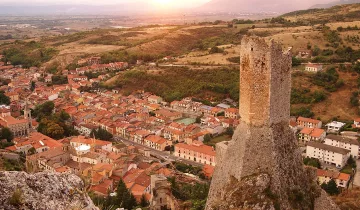
In so many ways. I come from Giulianova on the Adriatic coast. Later I lived for a long time in the hills, and for the past twenty-five years I have lived in Roio, a small village in the L’Aquila area, at the epicentre of the 2009 earthquake. This has allowed me to mix, almost like colours on a palette, many different aspects of Abruzzo: a territory rich in natural beauty and history, villages and people filled with stories, knowledge and traditions.
For an old-school artist like me, the stimuli are endless. The work of the hands is still central to this region. Here, it still seems that anything might be possible.
Your works seem to preserve traces, fragments and memories. How important is the concept of time within your art?
Just the other evening, I watched 2001: A Space Odyssey once again, a fundamental film in my own education, and one I hope will become part of my daughter Alma’s as well. She was watching it for the first time, just as she is about to enter the Academy this year, exactly forty years after I did. When she asked me what happens after Dave disconnects HAL 9000, I did not answer. I left her with the difficult task of finding out for herself.
Those of us of a certain age have asked ourselves this question, and we continue to ask it every time we stand before a canvas. The objects I collect, which I call “the gifts of the tide,” seem both to offer answers and to pose further questions. I would call them fragments of collective memory.
In the places where they accumulate, everything becomes mixed together, everything united by the same fate: branches, bones, fish scales, Nokia mobile phones covered in shells, plastic containers from the 1960s, pieces of glass smoothed by the sea.
Nature and the products of humanity eventually undergo the same destiny. In these “cemeteries”, my questions about time, and about the meaning of all this, become increasingly crowded. After almost an entire lifetime of searching, I still do not have a definitive answer.

You have also developed an important body of work around the pupazze, figures rooted in Abruzzo’s popular tradition. How did this relationship between contemporary art and popular culture begin?
I first saw the pupazze as a child, in my father’s arms, during the Festa della Madonna del Portosalvo in Giulianova. Many years later, this memory resurfaced with great force.
One evening in the mid-1990s, while watching the Ballata della Pupazza, I suddenly thought that I had to build them myself. After years of experimentation, in 200, while Kubrick’s Discovery spacecraft was travelling toward Jupiter, I began presenting myself as a maker of pyrotechnic pupazze in the villages around Roio, the place where I had recently moved.
I took part in various festivals with a fair amount of success.
Then, in 2007, Silvia came into my life. We began living together and sharing this passion. She immediately became a pupazza dancer, and together we created the Libera Pupazzeria.
Then came the earthquake. Silvia, who had by then become my wife, was expecting our second child, Francesco, and our work slowed considerably. But as soon as we were able, we started again, with even greater passion and determination. Over time, the Libera Pupazzeria became a cultural association working throughout the L’Aquila area and beyond, with workshops in schools and villages, pyrotechnic performances and themed parades.
The forms evolved: from the traditional pupazza, with the features of a voluptuous woman, to tall, stylised figures entirely in white, almost like ghosts. In the darkness of the nights following the earthquake, they evoked other lives, other times.
Silvia’s theatrical experience led us to transform the pupazza into a vehicle for telling stories that might otherwise have been lost. One example is Semi di Memoria, which recounts stories from the former psychiatric hospital of L’Aquila, where these enormous, silent white figures moved through the darkness, retracing places marked by pain and solitude.


Delicacy and strength, fragility and transformation coexist in your work. What emotions or questions do you hope to transmit to the viewer?
Precisely that these apparently contradictory qualities can coexist within us. From my point of view, strength and fragility are complementary. They are functional to a process of continuous transformation.
In art, this is inevitable. How could an artist not move, every day, through the entire range of emotions and possibilities? We return to the palette, to colours, to materials mixed together. These stages have to be lived, felt and crossed thousands upon thousands of times. One of the paintings I feel most attached to, and which I look at with renewed wonder every time, is The Return of Ulysses by de Chirico. Homer’s hero rows towards his destination on a small sea contained within a room.
De Chirico wrote:
“My room is a fantastic vessel, in which I can undertake adventurous journeys worthy of a stubborn explorer.”
The painting dates from 1968, the same year Kubrick’s film was released. The room in which the capsule ends up at the conclusion of 2001: A Space Odyssey seems to suggest a curious similarity with de Chirico’s room.
Who knows.
In an increasingly fast and digital world, what role can an art rooted in craftsmanship, materiality and a relationship with place still play?
I ask myself this question often, and I always come away defeated. But when I remember working in the countryside, when art meant nothing to anyone around me, I put my head down and continue along my own rough road. I have never even had a driving licence. By now, I will probably end as I began: collecting stones to paint on the beach, as I did on that windy afternoon in 1972, when I was happy.
Almost the whole world seems to rejoice at the arrival of new technologies. They do not interest me very much. I use a phone and the internet, but without any great enthusiasm. And yet I see, time and again, that when I arrive with a pupazza, everyone comes running, curious and excited, children and adults alike.
Or when I create an installation from discarded materials, people become deeply interested. They ask what it means, what path led me there. So there is still some room for incurables like me.
Looking back over your artistic journey, is there a particular work or project that represents a significant moment in your research?
Perhaps Campo di Grano from 1996.
Those were the years when I was working in the countryside. I was invited by my former Academy professor, Tullio Catalano, to participate in the exhibition Ad Usum Fabricae, organised by Catalano and Gianni Fileccia and curated by Laura Cherubini, at the Church of San Domenico in L’Aquila.
In the central nave, I created a rectangle of earth measuring twenty-five by ten metres. Hundreds of river reeds were held upright by a small ball of clay at their base, with a tiny brass leaf at the top. For me, it was a perfect synthesis: the work of the earth, art, spirituality, delicacy, strength, fragility and transformation.
What would you like a person to carry with them after encountering one of your works?
The fading of the hills towards evening.
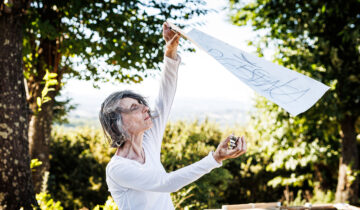
Massimo Piunti
An artist of matter, memory and place, Piunti continues to work at the intersection of the handmade and the conceptual, the personal and the collective. His practice reminds us that an artwork does not necessarily need to explain itself. Sometimes it is enough for it to leave behind an image:
a handful of stones,
a fragment washed ashore,
a white figure moving through the darkness,
a field of reeds inside a church,
or the hills slowly disappearing into the evening.
Perhaps, ultimately, this is what remains at the edge of the world.
Want more?
Original Question and Answer in italian

 No products in the cart.