
THE ART OF PAYING ATTENTION
Nature, memory and the quiet intelligence of seeing, an artist on listening, impermanence and the relationships that bind the living world.
There are artists who ask us to look. Silvia Stucky asks us to pay attention.
Across painting, photography, video, artist’s books, performance and installation, Silvia Stucky has developed a practice rooted not in spectacle but in observation. A leaf, the bark of a tree, a reflection on water, a childhood photograph, a word written by a stranger: in her work, the apparently insignificant becomes a threshold.
Her art begins with a form of listening, to places, to natural processes, to memory, and to the subtle exchanges between human beings and the world they inhabit.
The camera often remains still. The hand follows the texture of a leaf. Paper moves in the wind. A performance unfolds through the unexpected gestures of an audience. Again and again, Silvia Stucky relinquishes control in order to make space for something else to appear.
What emerges is an art of relation.
For Silvia Stucky, nature is not a backdrop to human experience. It is the complex living system of which we are already a part. Her practice therefore moves between intimacy and ecology, between personal memory and collective responsibility, asking a deceptively simple question:
What might become visible if we learned to look more carefully?
On nature, memory, participation and the possibility of seeing differently
1. Your artistic practice encompasses a wide range of forms, from painting and photography to video, installation and performance. How has this openness to different forms of expression shaped your work?
The path was actually the other way around. It was the evolution of my creative process that led me to use different forms of expression, in order to convey a particular thought or subject as precisely as possible. This is why some of my works share the same title while employing entirely different artistic languages.

Silvia Stucky – Je est une autre, 2016, dittico, fotografia digitale, disegno a penna su carta, 35,5 x 28 cm e performance.
Image by Claudio Palmieri
2. Listening seems to be at the heart of your practice. What does it mean for you to listen through art, and how does this attitude influence your creative process?
Listening lies at the foundation of my artistic practice. To listen and to see, which is another form of listening, means to pay attention. It means allowing oneself to experience wonder when looking at a tree, a single leaf, a reflection on water; to recognize the beauty inherent in natural processes.
In my videos, the camera is almost always fixed. This emphasizes a form of looking that, although it chooses a particular point of view, allows things to happen freely, casually and naturally.
Attention to everyday things can also generate images that become meaningful within the creative process. I often like to quote Giangiorgio Pasqualotto:
“The practice of paying attention to something simple or to an elementary movement trains body and mind in a particular attitude toward all living beings, excluding every form of subjugation or more or less violent use.”
3. Nature, water and landscape recur throughout your work. What kind of relationship do you seek to establish between human beings and the environment that surrounds them?
I would like to show that when we look at a landscape or a body of water, we are looking at something to which we are completely connected.
All natural processes are relationships; they are interconnections. Our small world is a miracle that makes life possible precisely because of the delicate balance of a network connecting every form of life, from the most elementary to the most complex, including us humans.
If we disrupt this balance too profoundly, we put our own existence at risk. It seems so obvious, almost banal, and yet we still have not understood it.
4. Many of your works begin with the observation of simple, everyday things. How do you transform what often goes unnoticed into an artistic experience?
From the cultures and philosophies of China and Japan, I have learned that everything, even the greatest things, originates in something small and perhaps hidden. Even a simple everyday gesture, or a blade of grass growing beside a wall, deserves our attention. These things possess a beauty that we can learn to see. The artistic experience, by seeing and revealing what is invisible, can awaken attention and wonder. It is this sense of wonder that, in Chinese, is expressed in the term miao (妙): something marvelous, exquisite, perfect, according to an order that does not exceed that of nature itself.
True naturalness is not the starting point of a discipline, but the destination toward which one strives, the culmination of an ideal journey toward artistic maturity and communion with the world
One must become natural.
Naturalness becomes perfect, becomes marvelous (miao), because it has been educated and refined through practice and work.
Here I am referring to François Jullien’s The Great Image Has No Form.

- Silvia Stucky, Frottage: la relazione delle cose 2026, installazione: matita su carta velina, 6 fogli, 149 x 33 cm, Botanical Garden, L’Aquila
5. How does a new work come into being? Does the creative process begin with an image, a place, an encounter, a reflection, or an intuition?
The spark can come from any of these things. Take, for example, the idea of frottage, which I recently used with the bark of trees at the Botanical Garden, in L’Aquila. The idea actually dates back to 2006.

- Silvia Stucky e Cinzia Colombo, Essere Vivere tutto è interconnesso 2026, installazione: tre faggi capovolti, Botanical Garden, L’Aquila
That year, I had a regular commitment that required me to walk along a particular stretch of road every week. Many of the garden walls along the way were covered with ivy. I began paying attention to those leaves, looking for something within their living texture. A kind of diary emerged from this attention. Every day, I made a rubbing of an ivy leaf, from March 21 the spring equinox to June 21, 2006, the summer solstice: ninety-three A4 sheets.
The frottages revealed the extraordinary beauty and diversity of the leaves, all taken from the same plant. Within the veins of each leaf lie the mysteries and laws of nature. I called the work Senza io : Without I. I exhibited it only in 2015, and it subsequently gave rise to other works, videos and installations.
In recent years, I have returned to the idea of frottage through a series of actions and performances, including several interventions in public spaces with other women artists, defending trees. At the Botanical Garden in L’Aquila, it felt entirely natural to me to imagine a work based on the rubbing of tree bark.
With the most basic tools of art, paper and pencil, one has to feel that delicate or rough texture. It is a work “without I” because the surface itself dictates the rules. I have to be careful not to force my hand; otherwise, I would tear the paper. Instead, I can witness the texture revealing itself, allowing the skin that envelops and protects the tree to emerge.
The strips of paper are attached to the branches, exposed to wind and time, participating in the impermanence of things. I want the wind to move them as it moves the leaves, because I do not want art to be inert or static, especially within a natural environment. It is a way of thinking about art as a means of provoking reflection on the natural world.
Humankind is bearing an increasingly heavier imprint on the world. Through my artistic practice, I want to explore other paths to seek out and preserve, for a limited but living moment, the splendor of nature’s texture. This is why I called the installation La relazione delle cose, The Relationship of Things.
And also because this intervention connects with the collaborative installation I created with Cinzia Colombo, in which we actually sow and germinate seeds and plant beech trees, in homage to Beuys and in defense of nature.

„corpo vestito di carta„, 2025, performance per il ciclo di eventi performativi “Dal corpo al corpo dell’arte”, a cura di Roberta Melasecca e Michela Becchis, Villa Altieri, Palazzo della Cultura e della Memoria Storica, Roma. Image by Francesca di Ciaula
6. Personal and collective memory play an important role in your practice. How do memory, experience and imagination intersect in the making of a work?
I can again refer to one of my works, which emerged from an encounter and an intuition, for an exhibition at the Archivio Menna Binga in Rome. Among the works in the archive’s collection is a photograph taken by Ketty La Rocca in 1973 of Filiberto Menna standing before a mirror by Pistoletto, creating a play of doubled figures. In 2016, this photograph became the focal point of an exhibition entitled Transfusioni #0, in which I participated alongside Tomaso Binga and Paola Romoli Venturi.
It was the first exhibition in a cycle that continued until 2020, curated by Anna D’Elia and Tomaso Binga. The exhibitions were connected by the idea of “trans-fusion”: the crossing of different artistic languages, the intertwining of personal and collective narratives, and reflections on otherness.
When I encountered Ketty La Rocca’s image, with its theme of doubling and reflection, an intuition immediately arose. In an instant, I conceived the work I would exhibit. My double would be a photograph of my mother as a child. Her reflection would be her twin who was never born. Alongside this photographic double, I created an ink drawing on paper of the two figures. Their outlines were formed, as in Ketty La Rocca’s works, through the repeated interweaving of their names.
The title, Je est une autre (“I is an other”), a gender-altering take on Rimbaud’s famous phrase Je est un autre, was also the title of a performance I presented in the same exhibition with a friend who resembles me. We sat silently beside one another, dressed alike, and appeared to be twins. Through images and actions, the personal world became intertwined with the broader question of identity and otherness.
7. In your work, the viewer is often more than an observer; they become part of the experience. How important is it for you to create a space of participation and relationship with the audience?
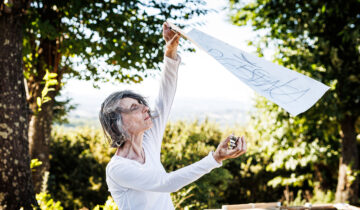
I am interested in giving the audience the possibility of participating in the work, and this has happened in many of my performances. In the performance corpo vestito di carta, Body Dressed in Paper, I wore a dress made of tissue paper, which I painted with a fine brush, following the accidental intersections of its folds. Then I turned toward the audience and said:
“Painting without I, meeting others in a word, sharing everything with everything, dispersing in order to preserve a bond.”
The audience was invited to write a word on the dress. The words would become gifts capable of preserving a connection. After everyone present had written a word on my paper dress, I tore it into as many pieces as there were words and distributed them randomly among the audience.
It was unexpected and beautiful to see people showing one another the words they had received (sometimes the words seemed to answer each other) or discovering, by chance, their own word on the piece of paper held by the person next to them.
The story continued afterwards through messages shared on social media.

- Senza io, 2006, matita su carta, 33,5 x 24 cm.
8. Your relationship with nature also involves a reflection on environmental change and the way we inhabit the world. What role can art play in creating greater awareness?
Art can play an important role in conveying messages that encourage reflection. It is precisely the way we inhabit the world that has moved beyond control and is approaching a point of no return. In 2021, after Covid, I created a collaborative project with the poet Giovanna Iorio and the musician Pierluigi Puglisi entitled Non abbiamo la stoffa delle tartarughe, We Are Not Made of the Stuff of Turtles.
The title comes from a passage in physicist Carlo Rovelli’s Seven Brief Lessons on Physics:
“I think our species will not last long. We do not seem to have the stuff of turtles, which have continued to exist much as they are for hundreds of millions of years, hundreds of times longer than we have existed.”
Rovelli continues by reflecting on the fragility of our species and the damage we are causing through climate and environmental change. His book was published in 2014. Since then, the situation has deteriorated further, as we can all see.
In 2025, I presented this work, consisting of seven photographs, seven poems and seven pieces of music, at Genoa Design Week, as part of the Festival del Tempo, curated by Roberta Melasecca.I accompanied the work with an extensive body of documentation concerning the state of water, forests and the Earth’s resources.
When visitors began to look carefully and read the documentation, they often stayed for a long time. They asked questions, wanted to share their own impressions and experiences, and sometimes followed the links on their phones. I believe that a small degree of awareness managed to make its way into those people’s minds and hearts.
9. Throughout your career, you have explored the boundaries between visual art, poetry, the body and space. What continues to stimulate your practice today?
Whenever I read a poem that moves me, I transcribe it and put it aside for a future artist’s book. I have always enjoyed creating books with texts by poet friends, allowing their words to meet my images. My images are often painted with a fine brush, drawing on traditional motifs from other cultures, China, Iran, India. It is almost as if the brush were tracing a network of flowers, water and geometric ornament. As for the body and space, performance is, for me, a way of interacting in which attention and improvisation meet.
For example, in my 2025 performance Misura delle cose, The Measure of Things, at the Nervi Pavilion in Magliana, Rome, the idea was to perceive and follow, through movement and sound, the curved surfaces and concrete volumes touched by the light of that particular space. The action itself was not predetermined.
10. When someone encounters one of your works for the first time, what feeling, question or experience would you like them to take away?
I am reminded of an episode from several years ago. I met someone who remembered having seen one of my videos, anima, in 2007. The work alternates fragments of Super 8 film shot by my father when I was a child with digital images I filmed myself, creating a clear distance between different times and between distant and intimate places. This person told me that they remembered certain images very clearly, and that the video had “a beautiful soundtrack.” In fact, the video was silent. They had imagined the music. This gave me enormous joy. That person had placed their own sound, and perhaps their own memories, inside my video, making the work their own as well.
11. Looking back on your artistic journey, what thought or advice would you offer young artists searching for their own voice and their own path?
Every artist must search for their own voice within themselves. Only by knowing ourselves can we look sincerely at the world outside us, and see its complexity, as well as the differences that shape cultures, arts and traditions. From this commitment, a personal and unique path can emerge, one that remains in dialogue with the particular time in which we live. The one thing that art can truly do is invite us to think. Knowledge and critical thinking might still save the world.

- „Non abbiamo la stoffa delle tartarughe“, 2021-2025, 7 fotografie digitali, 7 poesie, 7 brani musicali. Laboratorio con il pubblico. Image by Paul Bini
12. A more personal question: wine or beer?
I am teetotal. I drink water and tea. For around thirty years, I attended tea ceremony courses (cha no yu) with the teacher Michiko Nojiri at the Urasenke Centre in Rome. I eventually received my diploma as a tea master and was later invited to write the introduction to The Book of Tea by Kazukō Okakura, published by Rizzoli in 2025.
Silvia Stucky is an Italian contemporary artist whose multidisciplinary practice moves between painting, photography, video, artist’s books, performance and installation.
Her work explores perception, memory, nature, water, identity and the relationships connecting human beings to their environments. Drawing on an enduring interest in Eastern philosophies and visual cultures, Stucky approaches art as a practice of attention — a way of slowing down sufficiently to perceive what is often overlooked.
Her works frequently emerge from encounters with natural materials, everyday gestures, places and memories. Through participatory performances and site-specific interventions, she also investigates the relationship between artwork, audience and space.
Among her works are Senza io (2006), Je est une autre (2016), Non abbiamo la stoffa delle tartarughe (2021–2025), corpo vestito di carta (2025) and Misura delle cose (2025).
Based in Rome, Stucky has exhibited and presented her work in museums, archives, cultural institutions, public spaces and artistic contexts in Italy. Her practice continues to investigate one essential question: How might attention change the way we inhabit the world?
Selected Works
1. Senza io, 2006
Pencil on paper, 33.5 × 24 cm
2. Je est une autre, 2016
Diptych, digital photography, pen drawing on paper, 35.5 × 28 cm
3. corpo vestito di carta, 2025
Performance presented as part of the performance cycle Dal corpo al corpo dell’arte, curated by Roberta Melasecca and Michela Becchis, Villa Altieri, Palazzo della Cultura e della Memoria Storica, Rome.
4. Non abbiamo la stoffa delle tartarughe, 2021–2025
Seven digital photographs, seven poems and seven musical compositions.
5. Misura delle cose, 2025
Performance for Città Accogliente, Pier Luigi Nervi Pavilion, Open House Roma 2025.
Artist’s Books
Artist’s books featuring poetic texts, presented in an exhibition at the Biblioteca Vallicelliana, Rome.
Artist’s book created with Claudio Damiani, Open House Roma, 2023.
Want more?
Original language. italian
 Es befinden sich keine Produkte im Warenkorb.