Inside Matter
For decades, Patrizia Trevisi has explored the space between body and nature, surface and interior, memory and transformation. Moving between sculpture, painting, installation and Fiber Art, she turns canvas, fibres, plaster and organic forms into tactile landscapes that seem to carry traces of life, time and experience.
In this conversation, Trevisi reflects on the evolution of her artistic language, her fascination with the body and its hidden structures, and the role of material, time and place in her work.
1. Your artistic journey encompasses painting, sculpture, illustration, decoration, installation and Fiber Art. What have you sought over the years through such different languages?
I have never experienced these languages as separate paths. Rather, they have been different means through which the same research has taken shape and transformed over time. I have always sought the medium that would allow me to come closest to what I wanted to express.
Painting gave me surface and colour, but very early on I felt the need to move beyond two-dimensionality. I began working with plaster, modelling organic forms in high and low relief, and gradually volume became a fundamental component of my language.
My transition to canvas arose from this same need, but also from the desire to find a more ductile, elastic and physical medium. I model canvas because, for me, it has something profoundly akin to skin: it can be stretched, folded, made to contain volume, sewn, incised, wounded and reassembled. It can bear scars, stretch marks, tensions, pathways and textures, just as the human organism does. This is where my work in textile sculpture and Fiber Art originates.
Although I have worked across different techniques and materials, the core of my research has remained recognizable. I am interested in the organic, in what lives and transforms, in the relationship between body, memory and nature; in what happens beneath the surface and can become visible through form. Anatomy itself does not interest me as realistic representation, but as a language: a structure that I can transform in order to give form to tensions, mutations and inner processes.
For this reason, I do not consider my journey a succession of different languages. Rather, it is a research process that, over time, has found means increasingly suited to my need to construct forms and surfaces capable of behaving almost like organisms.
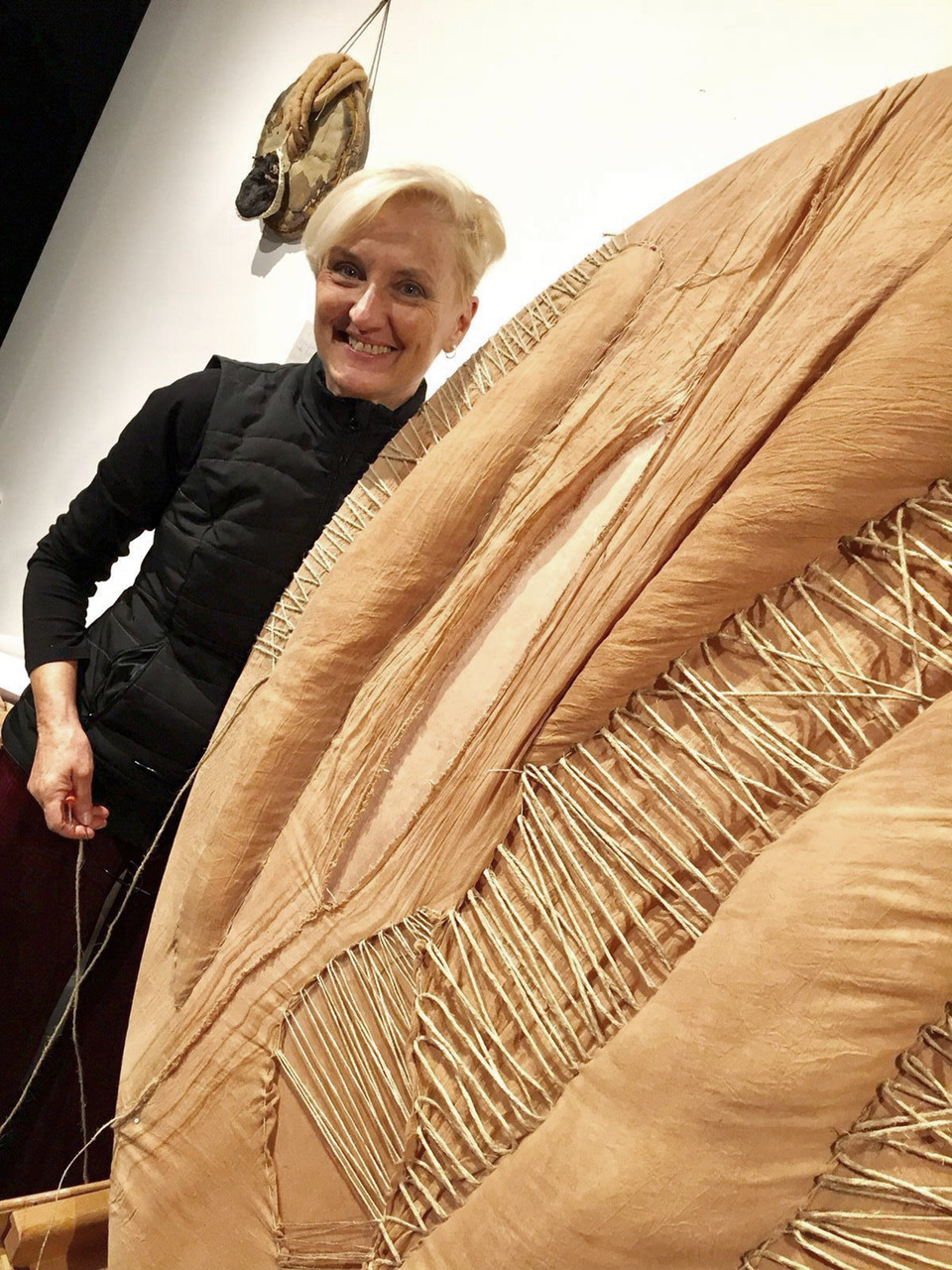
Patrizia Trevisi
2. Is it the language that changes, or is it the same question that continues to transform?
I would say both. There is a core that remains, but it is not static: it changes along with me, with my experiences, with what I observe and with the questions posed by the present. For this reason, the language also transforms. I have never felt the need to remain faithful to a technique; rather, I have felt the need to remain faithful to a way of seeing.
It is a gaze directed towards the organic and its processes: birth, transformation, vulnerability, the capacity to resist and regenerate. I am interested in internal structures, stratifications, the traces that time and experience leave on bodies and on matter. It is a territory that, in my work, may take the form of a body, a surface, an organism or, more recently, extend to nature and to the transformations human beings impose upon it.
I believe that an artist’s recognizability does not necessarily have to coincide with the repetition of a form, a technique or a material. For me, coherence lies in the gaze. If that remains recognizable, one can allow oneself the freedom to move through different languages and even to transform them profoundly.
Ultimately, what continues to transform in my work is not only the answer; it is the question itself. Each work contains part of it and, at the same time, opens up another.
3. In your works, matter often seems to take on an almost corporeal dimension: skin, flesh, veins, bones, wounds. Where does this intensely physical relationship with matter come from? And what can the body reveal that words cannot express?
The body is our first place, the first matter through which we experience the world. Even before conscious memory intervenes, the body feels, records, reacts and retains. It preserves traces that we are not always able to translate into words. It is this physical and, at the same time, inner dimension that interests me.
In my work, the body is almost never represented in its entirety or in a realistic way. Rather, I am interested in moving through it, ideally entering inside it and transforming its anatomy into a language. Skin, membranes, cavities, bones, tissues and veins become formal structures, organic territories through which I can speak of fragility and resistance, of wounding and regeneration, of what is continuously transforming within us.
This is why canvas has become so important in my research. It is not merely the support of the work: I treat it as a skin. I stretch it, model it, pad it, sew it, incise it and layer it. A stitch can become a scar, a tension can suggest a muscle or a membrane, a swelling can evoke something growing, and a cavity something that has been removed. Textures also participate in this language: they are epidermises, traces, maps of a real or imagined organism.
For me, however, the body does not coincide solely with anatomy. It is also memory, identity and experience; a symbolic and archetypal place. Through its transformation, I can approach something that belongs to the individual but, at the same time, goes beyond the individual.
Perhaps this is what the body is able to say before words: it makes a condition visible without necessarily narrating it. A wound, a tension, a cavity, a form that opens or contracts can be understood even before it is named. It is in this space, between what we recognize physically and what we perceive inwardly, that much of my work originates.

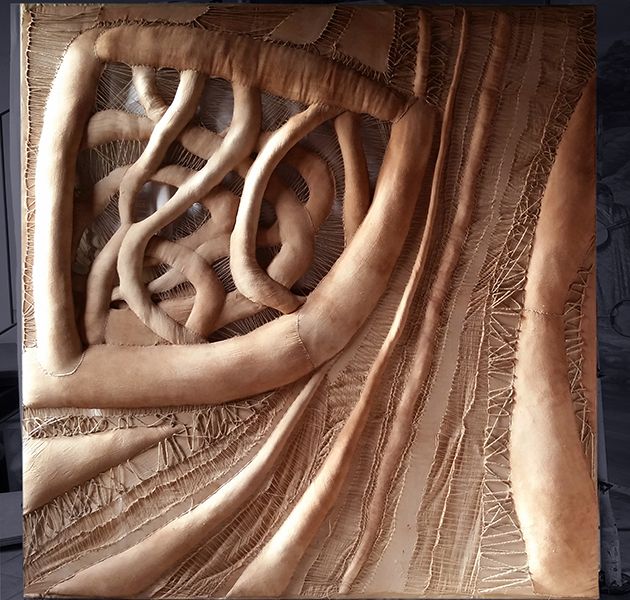
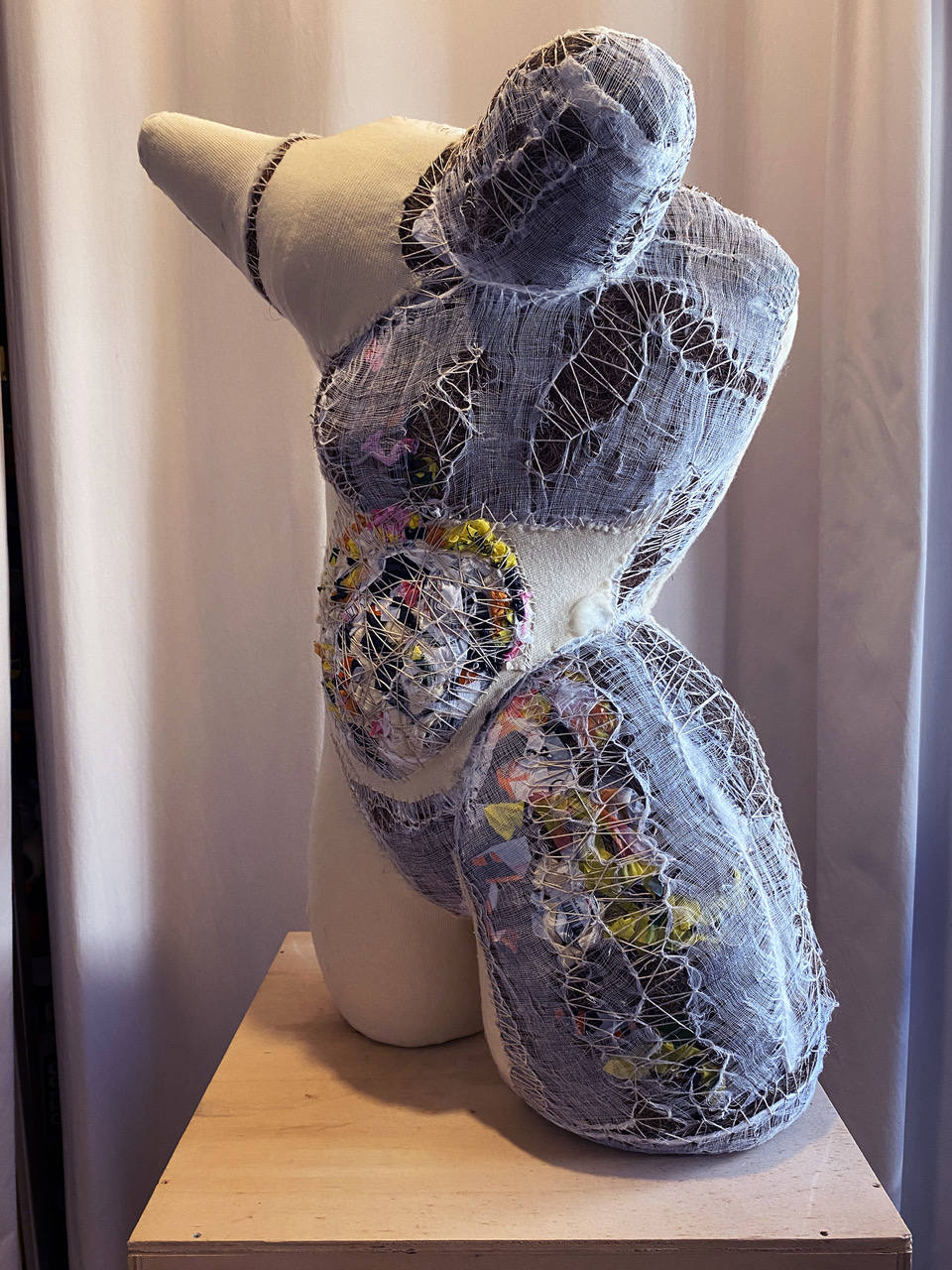
1 . INSIDE II – Dinamiche, 2017, 210 x 210 cm, Tela su telaio, cucita con cordini. Imbottiture di cotone.
2. INSIDE XI – Elogio della complessità, 2021, 65x65x85cm ,Scultura cucita in tela modellata con cordini. Imbottitura vegetale. Ricami con filo di cotone. Base di ferro.
3. MUTANS MATER, 2025,59x83x30 cm, Scultura tessile – Busto modellato con materiali organici, plastiche e tessuto acrilico
4. In works such as Inside, anatomy becomes a gateway to the psyche, while myths and archetypes seem to emerge from matter. How much of your work originates in personal memory, and how much belongs instead to a deeper, collective memory?
I cannot clearly separate these two dimensions. Every work inevitably originates in something that belongs to me: an experience, an emotion, an image, a memory, sometimes even a perception that is difficult to define. But I am not interested in narrating that experience autobiographically. The moment it enters the work, it is transformed, gradually loses its individual character and can enter into a relationship with something that also belongs to others.
In the Inside cycle, this process is particularly evident. The title itself indicates a movement inward, but that “inside” is not only psychological. It is simultaneously physical, organic and mental. Anatomy becomes a kind of inner geography: structures that may recall organs, membranes, cells, cavities or tissues are transformed until they lose any precise anatomical reference and become autonomous forms. The body thus becomes a landscape, a territory in which the physical and psychic dimensions can overlap.
It is in this transition that the archetypal dimension also enters. There are images and forms that cross different cultures and periods and continue to re-emerge: the cavity, the womb, the wound, the seed, the egg, the mother, birth, death, metamorphosis. I do not use them as a predetermined symbolic repertoire; they often emerge during the process of constructing the work, and only afterwards do I recognize their resonances.
This is why myth and archetype still interest me today. Not as something belonging exclusively to a remote past, but as deep structures that continue to operate in the present and through which we can recognize fundamental experiences of existence.
Personal memory, therefore, may be the origin of the work, but I would not want it to be its boundary. Rather, I seek that point at which what is individual loses its specificity and can become a form in which someone else may also recognize something of themselves.
5. Your research seems to move continuously between what we see on the surface and what lies hidden beneath it. Is this Inside, what we do not normally see, the true subject of your art?
Yes, I believe that the Inside is one of the constants of my research, but I would not understand it solely as psychological interiority. It is a much broader concept, concerning the body, memory, matter and, progressively, our relationship with nature as well.
I am interested in what is not immediately visible but acts upon form: what grows, changes, stratifies and leaves a trace. In the body, it may be an organic process or an inner tension; in matter, it may be time altering it; in nature, there are transformations that are often slow and imperceptible, yet capable of profoundly altering its balances.
This is why the surface has always played a fundamental role in my work. I do not consider it a boundary separating an outside from an inside, but rather the place where the two dimensions meet. The surface records what has happened: a pressure, a laceration, a stitch, a stratification, a scar. It is a skin that retains the memory of the transformations that have passed through it.
Textures also arise from this attention. For me, they are not a purely decorative element, but a formal language. Through reliefs, folds, stitches, superimpositions and variations in matter, I construct surfaces that demand a close gaze and, at the same time, suggest something that continues beyond what we can see.
Perhaps my interest lies precisely in this threshold: making perceptible what cannot be shown completely. Not revealing everything, but allowing the surface to preserve the ambiguity and mystery of what it contains.
6. In Sedimentazioni, time becomes almost a material: layers, superimpositions, fragments and traces construct a kind of emotional archaeology. What is your relationship with time? Are you interested in what time destroys, what it preserves, or what it transforms?
I am interested in all of these dimensions, but above all in transformation. I do not think of time only as something that passes or destroys; I perceive it as a force acting upon matter, bodies and memory. It deposits, wears away, modifies, conceals and, at times, precisely through these processes, brings to the surface something that was not visible before.
In Sedimentazioni, time takes on an almost physical consistency. The layers, superimpositions and fragments are not intended to reconstruct what has been, but to reveal its persistence. What we experience does not disappear completely: it leaves residues, traces and marks that are incorporated into what we are and into what comes afterwards.
I am very interested in this idea of stratification because it belongs both to nature and to the human being. We find it in the earth, in rocks and in bark, but also in skin, scars and memory. Each layer contains something of the previous one and, at the same time, modifies it.
This is also why I am drawn to marked, worn and imperfect surfaces. An intact surface tells us above all about its present; a surface traversed by time carries a history within it. Traces, fractures and abrasions are not necessarily a loss: they can become elements through which a form acquires a new identity.
In this sense, Sedimentazioni is not, for me, about nostalgia for the past, but about its transformation. The past remains within the present, altered, incorporated, sometimes almost unrecognizable, and continues to act upon what comes afterwards.
7. You have worked with very different materials and created works that engage with architecture, historical sites and public spaces. How important is it for you that a work belong to the place in which it originates, rather than simply being placed within it?
It is very important, particularly when I am working on a site-specific project. I am not interested in conceiving a work independently of a place and then adapting it to the space that will contain it. I prefer to begin with the place itself, to observe it and understand its characteristics before intervening.
Every space already possesses its own identity. An architecture carries with it a history, proportions, materials, stratifications, traces of what has happened there and also absences. But a place is also defined by the people who pass through it, by the behaviours that occur within it and by the relationships that are established there.
Aggregazione, a permanent work created for the Stadio Olimpico in Rome, originated precisely from observing the spectators in the stadium. The plaster modules, different in colour and arranged alongside one another, recall that multitude of individual presences which, through proximity, temporarily form a whole. I wanted the aggregation to be determined not only by an external compositional principle — rhythm, colour, solids and voids, but also by what I described at the time as an intrinsic “vocation for proximity” among the individual elements.
It is a principle that returns in my relationship with space. Initially, I try to place myself in a position of listening: sometimes an architectural element determines the form of the work; at other times it is the history, the light, a route, a memory or, as in Aggregazione, the very function of the place and the human relationships that take shape within it.
My intervention is not intended to impose itself upon the space or simply use it as a setting. Rather, I seek a relationship in which work and place can mutually alter the way each is perceived. The work introduces something that was not there before, but at the same time it can make visible a characteristic of the place that was already present.
When this happens, for me, site-specific work fulfils its purpose: the work could not be exactly the same elsewhere, because part of its form and meaning belongs to the place that generated it.
8. In De Rebus Naturae, matter seems to become an organism in transformation, suspended between nature, memory and metamorphosis. When you work, do you try to dominate matter, or do you rather listen to what matter suggests to you?
At first I try to dominate it, because I almost always begin with an idea and a planned form. But during the working process, that form enters into a relationship with the behaviour of the material, and a dialogue begins. Canvas, padding, fibres, threads and stitches react to my actions: tension produces an unexpected deformation, a stitch alters a volume, a fibre resists or takes a direction I had not anticipated. At that point, I am not interested in forcing the material to obey the initial project completely. I prefer to listen to it and understand what it can add to the work.
It is a balance that interests me greatly: I do not surrender form to chance, but neither do I try to control it to the point of neutralizing the vitality of matter. The work arises from this tension between intention and transformation.
In De Rebus Naturae, this process also takes on a broader meaning. The cycle originates in my reflection on the Anthropocene and on the relationship we have constructed with nature, often considering it as something external to ourselves, as matter available to be used, controlled and transformed. But we ourselves are nature; we are organic matter subject to the same processes of birth, transformation, deterioration and death.
For this reason, in the works of the cycle, the human body and the body of nature tend to merge. The forms may evoke organisms, tissues, roots, concretions, fossils, cellular structures or landscapes, without belonging definitively to any one of these worlds. It is precisely this ambiguity that interests me, because it challenges the separation between the human and the natural.
Alteration also enters into the work. The nature I observe is not an uncontaminated or idealized image, but a nature upon which human action has left profound traces. Wounding, transformation, adaptation and resistance therefore become processes that can concern an organism and an environment at the same time.
In this sense, the relationship I physically establish with matter while I work contains, on a very different scale, something of the same question posed by De Rebus Naturae: to what extent can we impose a form upon nature without listening to its reactions? For me, matter is not merely the means through which I represent this question. It is the very place in which the question takes form.
9. You have also moved through the worlds of illustration, advertising and cinema, as well as contemporary art. Have these more “applied” experiences influenced the way you look at art? And do you still believe there is a real separation between art and craft?
Yes, certainly, and I believe they contributed substantially to my formation. They are different experiences, each with its own rules and purposes, but above all they taught me how to look, how to plan and how to find solutions. When an idea has to become, concretely, an image or an object, one inevitably has to confront materials, techniques, time, limitations and unforeseen circumstances. It is a discipline that has remained with me and is still part of the way I work today.
I have never considered craft secondary to the idea. On the contrary, a profound knowledge of tools and materials allows an intuition to be taken further. Technique alone, of course, does not produce a work of art, but it can give an artist much greater freedom: knowing how to construct, modify, force or even contradict a process means having more possibilities through which to give form to what one imagines.
In my work, this aspect is particularly important because there is always a component of planning, even when, during the making of the work, I leave room for the reactions of matter and for the unforeseen. Experience allows me to understand when to follow the initial project and when, instead, a deviation may open up a possibility that I had not anticipated.
For this reason, I do not perceive a contradiction between thought and manual practice. Making is itself a form of knowledge. There are solutions and intuitions that do not arise before the work begins, but while the hands are working: through contact with a material, through resistance, through an error, through something that happens and alters the project.
I therefore believe that art and craft are distinct, but not necessarily separate. Craft does not guarantee art, of course, but it allows the artist not to depend entirely on the tools of others and to maintain a direct relationship between the idea, the gesture and the form being constructed. For me, an important part of an artist’s freedom arises precisely from this mastery.
10. After such a long career, what still surprises you? And is there a question, an image or a form that you feel you have not yet exhausted and that you continue to pursue?
I am still surprised by the fact that a work can take a direction I had not anticipated. One might think that, after many years of working and with a now profound knowledge of one’s own tools, the possibility of surprise would diminish. For me, almost the opposite happens: experience increases control, but it also makes us more aware of how much remains beyond our control.
I continue to be surprised by the ability of an apparently simple or everyday material to lose its original identity and become something else. A canvas, a fibre, a thread, through gesture, tension, stitching or stratification, can transform into something that seems to belong to an organism, an artefact or a natural form whose origin we cannot quite identify. It is that moment of transition, when matter ceases to be merely what it was and begins to suggest something else, that continues to fascinate me.
I do not believe, however, that there is a single image I am pursuing. There are questions that return: what happens beneath the surface, how a form is born and transforms, what the body retains, what relationship exists between our own matter and that of the natural world. These are questions that have run through my work for a long time, but they change along with me and with the time in which I live.
Perhaps this is precisely why I do not feel that I have exhausted them. For me, research does not necessarily progress by finding definitive answers; often an answer modifies the initial question and opens up a direction that did not exist before.
What I fear most would be reaching the point where I know too well what I am about to do, repeating a form because I know it works. I need a degree of risk to remain in the work, something I do not yet know. As long as that possibility exists, for me there is a reason to continue searching.
11. What advice would you give to a young artist who today feels the pressure to immediately find an identity, a market and an audience? Is it more important to protect one’s own voice, even when no one seems to be listening, or to learn to adapt to one’s own time?
This question is being asked of someone who has always described herself as a “lone wolf”, so perhaps I am not the most suitable person to give advice. I have always been far more absorbed in my own research, closed away in my studio, than interested in following the logic of the market. But if I had to say something to a young artist, first of all I would tell them to be patient.
Today there is enormous pressure for everything to happen immediately: one is expected to establish a recognizable identity very quickly, build a presence, be visible, communicate one’s work continuously, find an audience and, if possible, a market. I understand that all of this is part of our time, and I do not believe an artist can simply ignore it. But artistic research follows different rhythms. It needs time to sediment, to pass through doubts, changes, attempts and also mistakes.
Finding one’s own voice does not mean rapidly inventing a recognizable style. It means slowly understanding what truly belongs to us, which questions continue to return and which forms we are prepared to question. Sometimes it is also necessary to lose one’s way, to abandon something that seemed to work and begin again elsewhere.
Knowing one’s own time is essential. An artist does not live outside reality and inevitably absorbs what is happening around them. But knowing one’s time is different from continually adapting to its demands. If the market determines what form we should take, the risk is that research begins to pursue what is already recognized instead of discovering what we do not yet know.
For this reason, between the two possibilities, I would protect one’s own voice. Even during periods when it seems that no one is listening. Not in the sense of closing oneself off from dialogue or considering oneself impervious to the world, but in the sense of allowing oneself the time necessary for that voice to become truly one’s own.
Perhaps that is the advice I would give: look closely, know what is happening, learn the craft, work, make mistakes and continue searching. Without being in too much of a hurry to turn your research into a definitive identity.
12. And finally, the least philosophical question: wine or beer?
Wine. Definitely red, and in good company.
Original language italian
 No products in the cart.